An LED display maintenance SLA should define more than a supplier’s promise to “respond quickly.” It should identify the covered system, service hours, incident levels, acknowledgement and engagement targets, restoration expectations, onsite attendance rules, spare-parts responsibilities, escalation path, exclusions, and reporting method. Buyers need these fields in measurable language because a warranty alone does not describe how service will operate when a display is unavailable.
The right agreement depends on business impact, site location, system redundancy, service access, local technician coverage, and stocked parts. There is no responsible universal response target for every LED wall. This guide helps procurement, facilities, AV, and integrator teams build a service scope they can compare and manage.
What should an LED display maintenance SLA include?
Direct answer: an LED display maintenance SLA should include ten items: asset scope, support window, contact channels, incident severity, acknowledgement time, technical engagement time, restoration or workaround target, onsite attendance conditions, parts and labor responsibility, and performance reporting. It should also state exclusions, customer dependencies, escalation contacts, and what happens when a target is missed.
Each term must be defined. “Response” could mean an automated ticket email, a help-desk acknowledgement, or a qualified engineer beginning diagnosis. Those are not equivalent. Likewise, “resolution” may mean temporary service restoration or completion of the permanent repair. The contract should remove that ambiguity before an incident occurs.
What is an LED display service level agreement?
An LED display service level agreement is a documented set of measurable service commitments between the customer and support provider. It explains how incidents are submitted, classified, handled, escalated, measured, and closed. The SLA may sit inside a maintenance contract or appear as a separate schedule attached to it.
An SLA is not the same as a product warranty. A warranty normally addresses eligible defects and remedies within stated terms. An SLA governs the delivery of support: availability of assistance, process, timing, communication, evidence, and accountability. Buyers should evaluate both. KSS Display’s guide to LED display warranty and support explains the wider commercial questions that sit alongside the service schedule.
On smaller screens, swipe horizontally to view all columns.
| Document | Primary purpose | Key buyer question | Typical evidence |
|---|---|---|---|
| Warranty | Defines eligible defects, period, exclusions, and remedy | What product failure is covered? | Warranty terms, serial records, claim decision |
| Maintenance plan | Defines scheduled inspection and preventive work | What routine work will be performed? | Calendar, inspection checklist, service report |
| SLA | Defines measurable support delivery | How will an incident be handled and measured? | Ticket timestamps, escalation record, restoration and closure data |
| Operating procedure | Defines approved daily and exception actions | What should the operator do first? | Operator log, alarm details, approved checklist |
Start with operating impact, not a generic SLA package
Service targets should reflect what the wall does for the organization. A lobby display, executive briefing wall, broadcast background, transport information board, retail media screen, and live-event system do not carry the same consequence when unavailable. Document the critical operating periods, acceptable degraded modes, alternative communication channels, and financial or operational impact of downtime.
System design changes the service requirement. A wall with validated signal redundancy, spare modules onsite, front access, and trained local staff may be restored differently from a remote installation with restricted access and no local inventory. Connect the SLA to the approved as-built documentation, rather than describing an abstract display that does not match the field installation.
Define incident severity with observable conditions
A severity matrix should use visible business and system conditions. Avoid labels such as “critical” or “minor” without criteria. A highest-severity incident might involve complete loss of a mission-critical canvas during its contracted operating period, but the exact definition belongs to the buyer’s use case. Partial image loss, loss of redundancy, an isolated module defect, content-source failure, cosmetic variation, and an operator question may belong in different levels.
The matrix should also state who can assign or change severity. If the help desk can downgrade a ticket, require a reason and named approval route. If several issues occur together, define whether they are handled as one system incident or separate component cases. The customer’s black-screen recovery plan can provide the first evidence needed to classify a loss-of-image event.
- Business condition: Is the display required now, and is an alternative available?
- Display condition: Is the full canvas, a large region, or a limited area affected?
- Resilience condition: Has service failed, or has redundancy been lost while the image remains available?
- Safety boundary: Is there smoke, water, electrical damage, structural concern, or another condition governed by the site emergency plan?
Separate acknowledgement, engagement, restoration, and resolution
LED display response time is often misunderstood because one clock is used for several different events. Define at least four milestones. Acknowledgement confirms that the case was received. Technical engagement begins when a qualified resource reviews evidence or contacts the site. Restoration returns the required service, possibly through an approved workaround. Resolution completes the permanent corrective action and required documentation.
State when each clock starts, pauses, resumes, and stops. For example, a clock may pause while the supplier waits for customer-authorized access or requested diagnostic information, but only if the contract defines that dependency. Make the time source and ticket record authoritative. Otherwise, both parties may hold different versions of the same incident timeline.
Specify service hours, channels, and communication cadence
Define the support window in the site’s local time, including holidays and planned closures. If critical events occur outside normal hours, specify whether extended coverage is included, pre-booked, or separately charged. The agreement should name the approved ticket portal, phone number, email address, and emergency contact route. Messages sent to an individual salesperson should not silently become SLA tickets unless the contract says so.
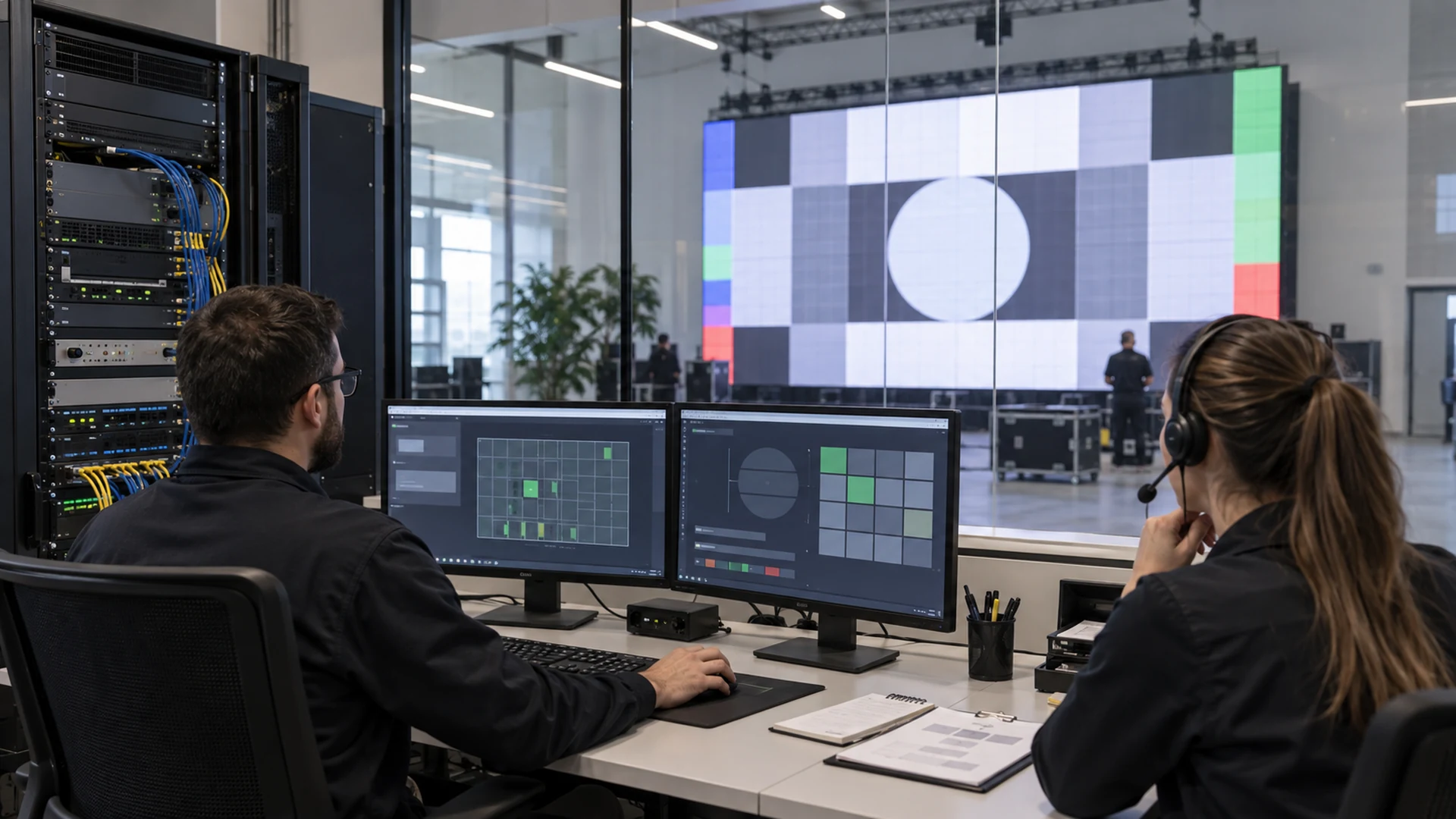
For active incidents, set a communication cadence by severity. Updates should state current impact, work completed, evidence found, next action, responsible party, dependencies, and the next update time. This provides operational value even when a permanent fix requires parts or site attendance.
Define the remote triage evidence package
Remote support is faster when the operator can provide consistent evidence without attempting unauthorized repair. The SLA should identify the expected ticket fields: site and display ID, contact details, time detected, operating mode, affected area, current source, alarm or monitoring state, recent changes, whole-wall photo, close view where safe, and actions already taken.
Access to monitoring, processors, or control systems must follow the customer’s cybersecurity and authorization policies. Define the approved remote-access method, permitted hours, session approval, logging, and credential ownership. Do not embed shared passwords in the service document. The daily startup and shutdown plan should also tell operators which evidence to preserve before escalation.
Set onsite attendance and spare-parts responsibilities
An onsite target is credible only when the contract defines the service geography, technician origin, travel assumptions, access restrictions, work permits, escort requirements, lifting equipment, and safe working hours. Clarify whether the target means arrival at the site gate, access to the display, or a qualified technician ready to begin work.
Parts availability is a separate dependency. List the customer-held and supplier-held spares, compatible batches, storage conditions, replenishment responsibility, shipping method, customs responsibility where relevant, and approval process for consumption. Link this scope to the project’s LED display spare-parts plan and module replacement procedure. A rapid attendance promise cannot guarantee restoration if the required compatible part is not available.
Write exclusions and customer dependencies clearly
Exclusions should be specific enough to price and manage. Common project questions include third-party source equipment, building power, network availability, environmental conditions, unauthorized changes, physical damage, consumables, access delays, special lifting, content errors, and work outside the contracted region. Do not hide major exclusions in a generic “other causes” clause.
Customer responsibilities should be equally clear: maintaining safe access, naming authorized contacts, preserving required environmental conditions, keeping the asset register current, providing timely evidence, and following approved operating procedures. The agreement should explain how a disputed dependency is documented and who decides the next step.
Measure service performance without misleading averages
Monthly or quarterly reporting should show ticket count by severity, acknowledgement performance, technical engagement performance, restoration performance, open-case age, repeat incidents, parts used, onsite visits, excluded cases, and missed-target reasons. Report the number of eligible incidents as well as the percentage achieved. A perfect percentage based on one case and the same percentage across many cases do not provide the same management context.
Define planned maintenance, customer-caused delays, duplicate tickets, and monitoring-only alerts before calculating results. Review recurring fault patterns and corrective actions, not only elapsed time. If service credits or other remedies apply, describe eligibility, calculation, claim timing, and any cap in unambiguous commercial language.
LED display support checklist for procurement
- List every covered display, processor, controller, distribution component, monitoring service, and third-party boundary.
- Define support hours, local timezone, holidays, contact channels, and event-specific coverage.
- Write severity levels using observable operational conditions.
- Separate acknowledgement, technical engagement, restoration, and permanent resolution targets.
- Specify ticket evidence, remote-access controls, update cadence, and escalation authority.
- Define onsite attendance geography, access assumptions, labor scope, travel, and special equipment.
- Assign spare-parts ownership, compatibility control, storage, shipping, consumption, and replenishment.
- Record exclusions, customer dependencies, reporting fields, review frequency, and remedies.
Frequently asked questions
Does an SLA guarantee that an LED wall will never go down?
No. An SLA defines how support is delivered and measured after a qualifying incident. Availability depends on the complete design, installation, operating environment, redundancy, maintenance, parts, and user processes. Avoid any contract wording that confuses a support target with a guarantee of failure-free operation.
What is the difference between response time and resolution time?
Response time records an early service milestone, such as acknowledgement or qualified technical engagement. Resolution time records completion of the permanent corrective action. Service restoration may occur between them through an approved workaround. The agreement should define and measure each milestone separately.
Should preventive maintenance be part of the SLA?
Preventive maintenance can be included in the same contract, but its scope and schedule should remain distinct from incident targets. State inspection frequency, tasks, access needs, deliverables, defect reporting, and whether corrective work is included or quoted separately.
How should buyers compare two LED wall maintenance contracts?
Normalize the scope first. Compare each LED wall maintenance contract across covered assets, hours, incident definitions, clock rules, technical engagement, restoration, onsite conditions, parts, exclusions, reporting, and remedies. A lower price or shorter headline response is not comparable if the underlying service scope is different.
Make the SLA operational before acceptance
A useful LED display maintenance SLA translates operating impact into defined actions, clocks, responsibilities, evidence, and review data. Finalize it with the asset register, as-built documents, spare-parts plan, access rules, and escalation contacts. Then test the process during handover with a sample ticket and supervised response exercise.
To prepare an LED display maintenance SLA for a new project or an existing service review, gather the site location, screen configuration, operating hours, critical events, access conditions, available redundancy, onsite spares, and required coverage window. Review KSS Display’s support capabilities and contact the project team to discuss a service scope matched to the installation.