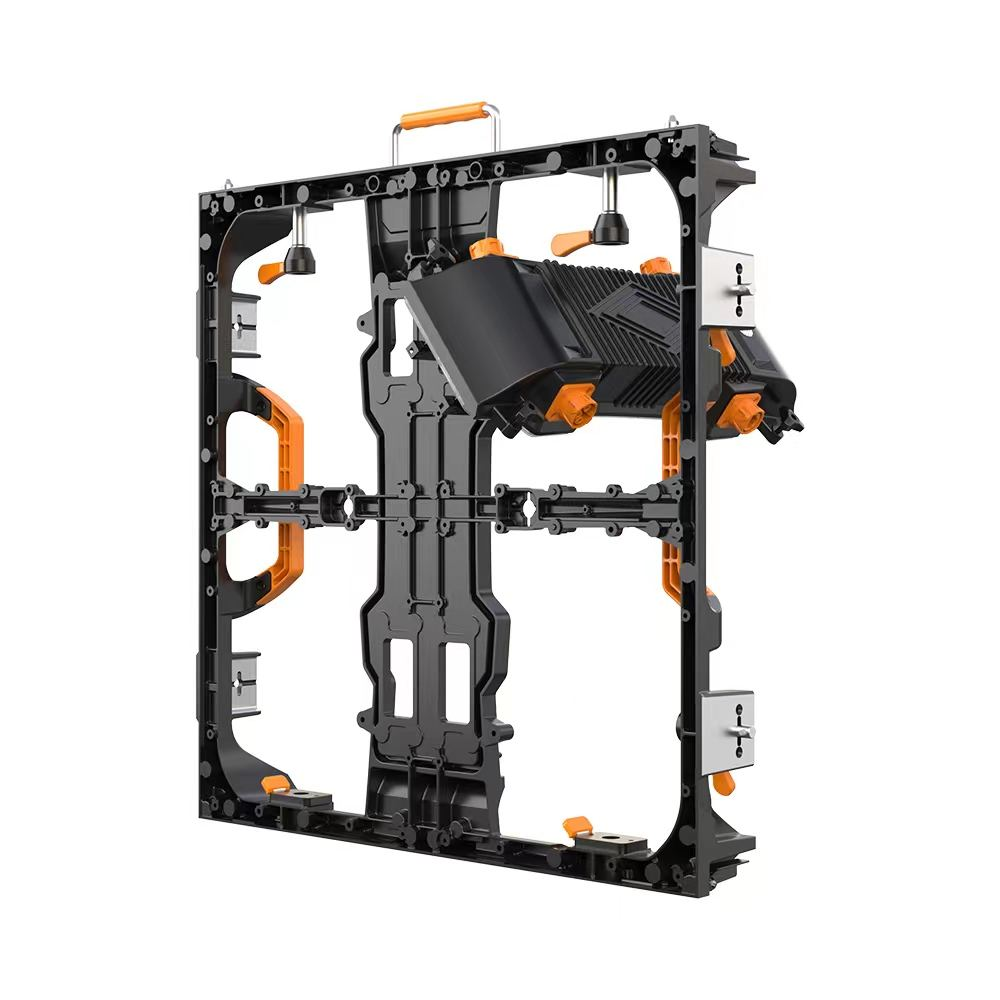
An LED display warranty claim moves faster when the buyer can identify the exact failed item, show the operating context, preserve configuration evidence and agree on the return route before shipping anything. The practical sequence is: make the site safe, record the symptom, isolate the fault without unauthorized alteration, review the agreed warranty terms, request a return merchandise authorization (RMA), protect the item in transit, and verify the repaired or replacement part before closing the case.
An RMA number is not, by itself, a decision that the work is covered at no charge. It authorizes a controlled return and connects the package to a case. Coverage, freight, labor, customs, access equipment and consequential site costs depend on the signed terms and the evidence for that specific failure. This guide helps procurement, integrators and operators build a traceable process; it does not replace the project contract or model-specific service instructions.
What should happen before an LED display warranty claim is opened?
Start with safety and service continuity. If the symptom involves heat, odor, smoke, exposed conductors, water entry, unstable structure or another immediate hazard, stop normal troubleshooting and follow the site’s emergency and isolation procedure. A warranty workflow must not encourage an operator to open energized equipment or work outside their authorization.
Record what the operator first observed before restarting, swapping parts or changing configuration. Capture the date and local time, screen area, content source, operating state, environmental condition and any alarms. Take wide photographs that establish location and close photographs that show the affected area and identification labels. Preserve the original files rather than relying only on images compressed by a messaging app.
If the site has an approved recovery procedure, record every step and its result. The goal is not to prove a theory; it is to separate observations from actions. The LED display incident report template can hold the first timeline, while the maintenance log template keeps later work connected to the asset record.
Which evidence makes an RMA request usable?
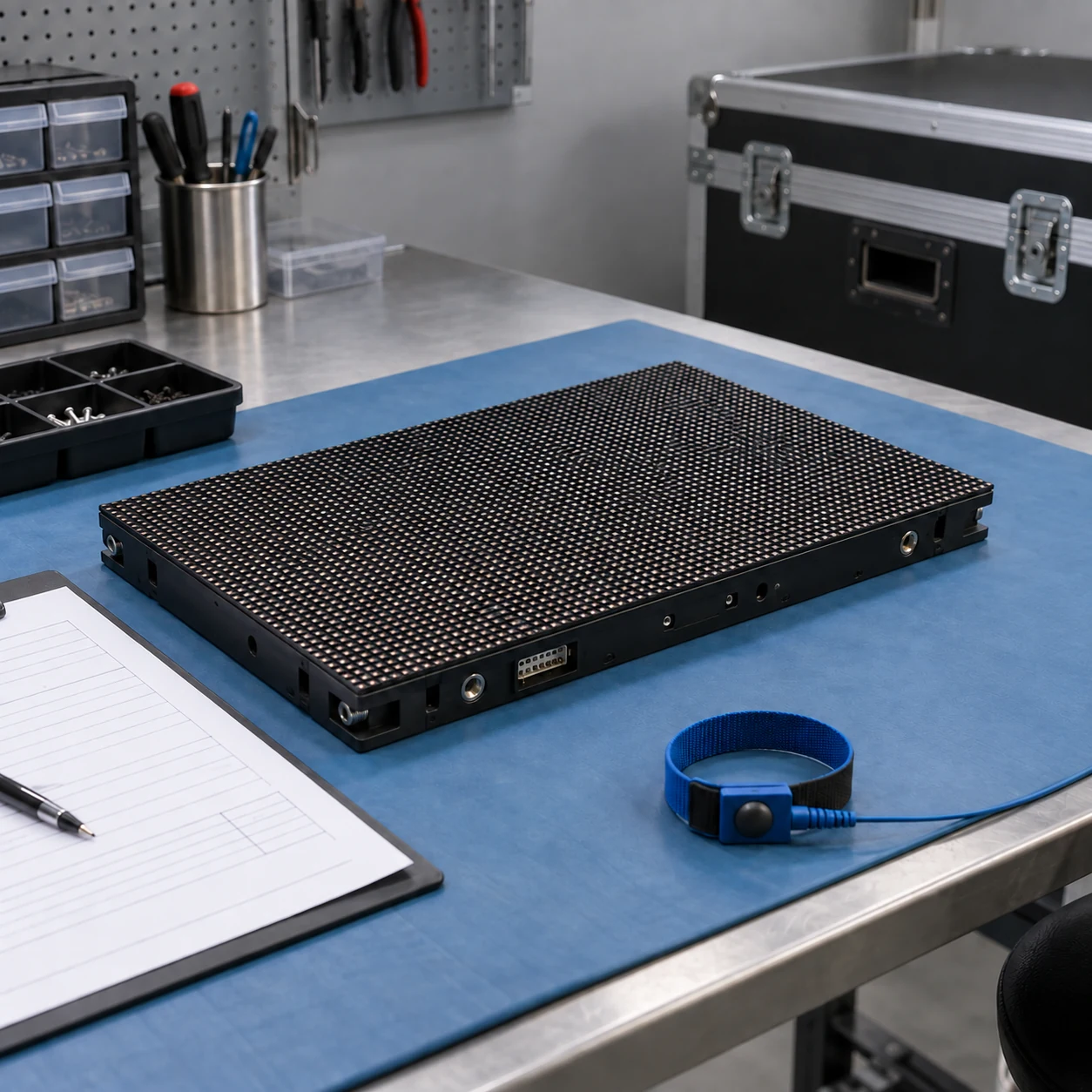
A useful claim package lets the service team answer four questions: what item is involved, where and how it was used, what failed, and what has already been checked. A phrase such as “module not working” does not identify a repair path. A long video without a case reference or configuration record may be equally difficult to use.
Build one evidence register for the case:
On smaller screens, swipe horizontally to view all columns.
| Evidence field | What to provide | Why it matters |
|---|---|---|
| Project and asset identity | Site, screen ID, cabinet position and responsible contact | Links the claim to the installed system and service history |
| Product identity | Part number, serial number, revision, batch or other available identifiers | Prevents a visually similar but incompatible item from being assessed |
| Purchase and coverage record | Order, delivery or commissioning reference and the applicable warranty document | Establishes which commercial terms need review |
| Symptom and impact | Plain description, affected area, frequency and operational consequence | Helps triage the case without overstating the cause |
| Time-stamped evidence | Original photos, short videos, alarm records and relevant logs | Shows the observed condition and sequence |
| Configuration evidence | Controller, receiving-card or software versions and a controlled configuration export where relevant | Separates hardware symptoms from configuration changes |
| Actions already taken | Approved restart, cable check, known-good substitution or other authorized test | Avoids repeating work and exposes changes that may affect diagnosis |
| Current condition | Installed, isolated, removed, packaged or unavailable for inspection | Determines the next safe and practical step |
Use filenames or a case folder structure that preserves the asset identity and capture date. Keep conclusions out of the filename. “Cabinet-C04-output-dark-2026-09-23.jpg” is more useful than “bad-card-final.jpg” when the root cause has not been confirmed.
Does an RMA approval mean the repair is under warranty?
Not necessarily. Treat return authorization and warranty coverage as two separate decisions. The RMA controls receipt, tracking and routing. The coverage review applies the agreed exclusions, time limits, responsibilities and evidence to the inspected item.
Before dispatch, ask the supplier to state the current case status in writing. Useful labels include “return approved for inspection,” “warranty coverage confirmed,” “chargeable evaluation pending approval,” or “additional evidence required.” The exact wording can vary; the important point is that procurement can see whether a cost commitment exists.
Review the actual contract, quotation, warranty statement and handover documents. Do not infer coverage from a marketing page or another project’s terms. Clarify whether the agreed remedy is repair, replacement, credit or another option, and whether removed parts become the supplier’s property. If terms conflict or the commercial impact is material, route the question through the organization’s contract owner or legal adviser.
Who is responsible for removal, packing and freight?
Product warranty and site work are different scopes. Even when a component is covered, the agreement may assign isolation, access, removal, packing, outbound freight, import/export formalities, reinstallation, configuration and final testing to different parties. Build the responsibility split before the item leaves site.
On smaller screens, swipe horizontally to view all columns.
| Activity | Responsibility to confirm | Evidence at handover |
|---|---|---|
| Safe isolation and removal | Qualified site team, integrator or supplier | Work record, part identity and condition photographs |
| Packaging method | Party following the approved packing instruction | Images of protection, connectors, seals and closed package |
| Outbound logistics | Buyer, seller or nominated carrier | Tracking number, declared contents and dispatch date |
| Customs and temporary export | Named importer/exporter and broker where applicable | Commercial documents and return-reference details |
| Inspection and quotation | Authorized service center | Receipt confirmation, inspection finding and approval request |
| Repair or replacement | Party defined by the accepted outcome | Repair record or replacement identity |
| Reinstallation and acceptance | Qualified site team with owner approval | Test result, updated asset record and case closure |
Never ship a component to an address taken from an old email without reconfirming the active return location and case number. Ask whether the RMA must appear on the outer package, the shipping documents, or both. Confirm prohibited packaging materials, electrostatic protection, moisture protection and orientation for the specific item.
Photograph the part from all sides before packing. Protect exposed connectors, prevent movement inside the package and avoid adhesive labels on sensitive surfaces unless instructed. Retain the serial number and package weight in the dispatch record. These controls help distinguish transit damage from the reported fault without claiming that packaging alone determines liability.
How should returned controllers and storage media be handled?
Some control equipment may store configuration files, network details, credentials, logs or other organization data. Before returning it, identify what information the device holds and whether erasing it would remove evidence needed for diagnosis or make recovery harder. Do not reset or wipe a device simply because it is leaving site.
Agree on a data-handling decision with the system owner and service provider. That may mean exporting an approved backup, documenting what remains on the device, removing organization-controlled media when the service route permits, or using an authorized sanitization method after evidence is preserved. The current NIST SP 800-88 Rev. 2 frames media sanitization as a risk-based program tied to information sensitivity and the media involved. It is a useful security reference, not a universal instruction to erase every controller and not a statement of the warranty terms.
Keep passwords and reusable credentials out of the ordinary claim form and shipping label. Use the organization’s approved credential-transfer method only when diagnostic access is required and authorized. Record who approved the access and when it should be removed.
What should the service center report after inspection?
Request a finding that separates the reported symptom, reproduced condition, inspection result and proposed action. “No fault found” should state what configuration and test conditions were used. “Physical damage” should identify the observed location and evidence rather than relying on a generic label.
For a chargeable repair, ask for the repair scope, price, validity period, lead-time basis, return freight and what happens if the quotation is declined. For a replacement, confirm whether the item is new, repaired or functionally equivalent under the agreed terms, and record its identifiers before installation. Compatibility with an older cabinet, receiving card, calibration file or batch should be confirmed for the real configuration rather than assumed from a broad product name.
If a proposed substitute differs from the removed item, connect the decision to the LED display obsolescence and replacement planning guide. A warranty case should not introduce an undocumented configuration change that creates a later support problem.
How do you accept a repaired or replacement LED component?
Receipt is not the end of the case. Inspect the package for visible damage before discarding it, match the item and paperwork to the RMA, and quarantine unexpected substitutions until they are reviewed. Record any changed part number, serial number, revision or firmware level.
Use a project-appropriate acceptance check after qualified installation. The check may include power-up behavior, signal path, mapping, relevant alarms, visual uniformity, operation with the approved configuration and a defined observation period. The applicable list depends on the component and project. Do not present a generic functional test as proof of electrical safety, structural adequacy or long-term reliability.
For LED modules, a visible image alone does not prove an acceptable match. Compare the repaired area with agreed content and viewing positions. If calibration or configuration changes are applied, store the updated files and record who approved them. The module replacement plan covers the site-side control of that work.
Close the RMA only after the owner has the outcome, the installed identity is correct, stock records are updated, costs are assigned and any temporary workaround is removed. Feed the confirmed failure and remedy into the maintenance history so the next claim starts with evidence rather than memory.
LED display warranty claim checklist
Before requesting an RMA, confirm that the case contains:
- the project, screen and component identity;
- the observed symptom, time, location and operational impact;
- original photographs, short videos and relevant logs;
- purchase, delivery or commissioning reference;
- the applicable warranty or service terms;
- a record of every authorized troubleshooting action;
- the current physical and configuration state;
- a named contact for technical and commercial questions;
- the requested next step: remote review, site instruction or return authorization;
- written responsibility for removal, packaging, freight, customs, evaluation and reinstallation;
- data-handling instructions for any device that stores information;
- acceptance criteria and the evidence needed to close the case.
What should you send when asking KSSdisplay for support?
Start with the screen location and application, purchase reference, exact affected item, symptom, photos or video, configuration information, actions already taken and the operational deadline. State whether the equipment is still installed and whether the site can safely isolate it. Do not send an unidentified part or sensitive credentials in the first message.
Use the KSSdisplay enquiry form to request a project-specific review. The available route, coverage decision and return instructions must be confirmed against the supplied product identity and agreed terms.
Frequently asked questions
Can we return a failed LED module without an RMA number?
Do not assume so. Obtain the active return address and authorization first. An unannounced package can be delayed, misrouted or separated from the technical evidence needed to inspect it.
Should we remove the failed part before contacting the supplier?
Only when site safety, continuity and the approved service process support removal. Record the installed position and identification before changing the system. The supplier may first request remote evidence or a controlled substitution test.
Who pays the shipping cost for a warranty return?
The signed commercial and warranty terms control that answer. Confirm outbound freight, return freight, insurance, customs charges and any inspection fee in writing before dispatch rather than assuming “under warranty” covers every logistics cost.
What if the service center cannot reproduce the fault?
Ask which configuration, content, duration and environmental conditions were used. Compare those conditions with the original evidence. A periodic or site-dependent symptom may require more targeted logs or an agreed observation method rather than an immediate conclusion that no problem existed.
Can a different revision be supplied as the replacement?
It may be possible, but the revision should be identified and approved for the actual system. Confirm physical, electrical, control and visual compatibility, then update configuration and asset records after acceptance.