The lowest LED wall quotation is not always the lowest-cost system to own. Purchase price is visible on day one, while power, installation labor, spare parts, service access, downtime, recalibration, and future expansion appear over several years. A total-cost-of-ownership comparison does not require perfect predictions. It requires suppliers to answer the same questions and buyers to document the assumptions behind each option.
Set a common comparison period and use profile
Choose a planning horizon that fits the project—often several budget cycles—and define expected operating hours, brightness schedule, content type, ambient conditions, maintenance access, electricity price, and required availability. Compare systems at the same active dimensions and performance target. A finer pitch or higher maximum brightness should not be treated as free value if the application will not use it.
Separate acquisition cost from installed cost
The product quote may exclude structure, trim, power distribution, video processing, control equipment, freight, taxes, lifting, installation, commissioning, calibration, training, and site preparation. Create one installed-cost schedule that includes every required scope and names the responsible party.
On smaller screens, swipe horizontally to view all columns.
| Cost group | Inputs to collect | Common hidden variable |
|---|---|---|
| Equipment | Cabinets, processor, distribution, spares, accessories | Incomplete signal or cable scope |
| Installation | Structure, labor, access, lifting, trim, commissioning | Service clearance or flatness correction |
| Energy | Typical watts, maximum watts, hours, tariff, cooling impact | Using maximum power as the only estimate |
| Maintenance | Inspection, cleaning, parts, labor, access equipment | Front versus rear service workflow |
| Downtime risk | Criticality, response time, redundancy, spare availability | No cost assigned to unavailable screen time |
| End of term | Reconfiguration, resale, recycling, removal | Disposal and access costs |
Model energy with typical and maximum power
Maximum power is needed for electrical design, but it may overstate normal energy use. Typical consumption depends on brightness, content, image settings, and operating schedule. Ask every supplier to state the test conditions behind both figures. Then use a simple annual estimate:
Annual energy (kWh) = typical operating power (kW) × operating hours per year
Add standby behavior, control equipment, and cooling where material. For buyers placing certain display products on the European Union market, the European Commission maintains current information on ecodesign and energy-label rules for electronic displays. Scope and exemptions can be product-specific, so regulatory applicability should be confirmed rather than assumed for a modular LED wall.
Value service access in labor hours
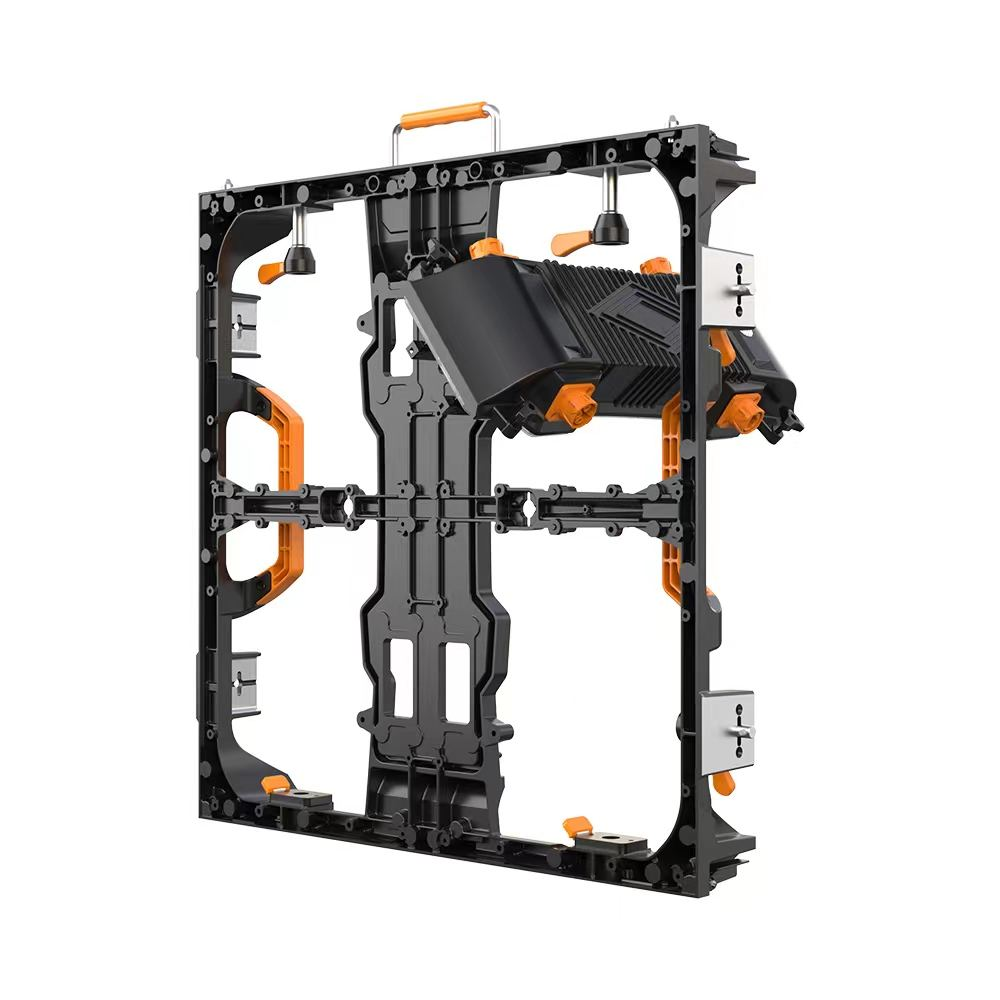
A front-service design can reduce the need for a rear corridor, while a rear-service design may suit a structure with permanent access. The important question is how long common tasks take in the real installation. Ask suppliers to demonstrate removal of a module, power supply, receiving card, and hub board. Include access equipment, security procedures, and business disruption in the labor estimate.
The commercial LED display solution can be planned around different locations and service needs. Compare product families through the main LED and LCD display catalog, but confirm the exact maintenance workflow for the proposed model.
Price the spare strategy, not only the spare box
Spares reduce downtime only if they match the installed batch, remain organized, and can be fitted and calibrated. Request a component-level spare list, storage requirements, software or calibration files, expected part availability, and repair turnaround. Consider holding complete cabinets for critical installations where a cabinet swap is faster than component diagnosis.
Compare failure response and support boundaries
- Who performs first-line diagnosis and what training is included?
- What remote access, logs, or monitoring tools are available?
- Which parts are field replaceable and which return to a repair center?
- What are the response targets, shipping terms, and exclusions?
- How are replacement modules matched to the installed screen?
- What documentation is delivered at handover?
Supplier quality processes affect the probability of early corrective work. Review the proposed inspection and aging records alongside KSSdisplay’s quality-control overview, and define the project-specific evidence required before shipment.
Include technology and expansion risk
A wall may remain mechanically serviceable while matching modules, receiving hardware, or software become harder to source. Ask how long the supplier expects to support the model, whether later cabinets can match the original dimensions and color performance, and which controller upgrades might be required. If future expansion is likely, buying a small quantity of matching material and retaining configuration files can be cheaper than rebuilding a section later.
Also identify refresh triggers: a business move, new camera workflow, higher-resolution content, change in signage regulation, or unacceptable downtime. TCO should not assume the screen runs forever, but it should avoid replacing equipment simply because lifecycle assumptions were never discussed.
Document what happens to removed equipment as well. De-installation, transport, resale, redeployment, parts harvesting, and responsible recycling can carry costs or recover value. The estimate can remain conservative, but it should not treat end-of-term work as free.
Run three scenarios instead of one forecast
A base case alone can create false precision. Model a low-use case, expected case, and high-use or high-energy-cost case. Vary operating hours, electricity price, service labor, and one significant component event. The goal is to see whether the ranking changes. If one option only wins under optimistic assumptions, the buyer can investigate that risk before award.
Ask for data in a comparable TCO worksheet
Send each bidder the same active size, brightness target, operating schedule, service constraint, planning horizon, and required availability. Request installed scope, typical and maximum power with test conditions, spare recommendation, warranty and repair process, cabinet-level replacement time, and upgrade limitations.
For a project comparison, contact KSSdisplay with the screen dimensions, use profile, electricity assumptions, access conditions, and expected support model. A complete input set makes it possible to compare configurations on operating value, not only initial price.