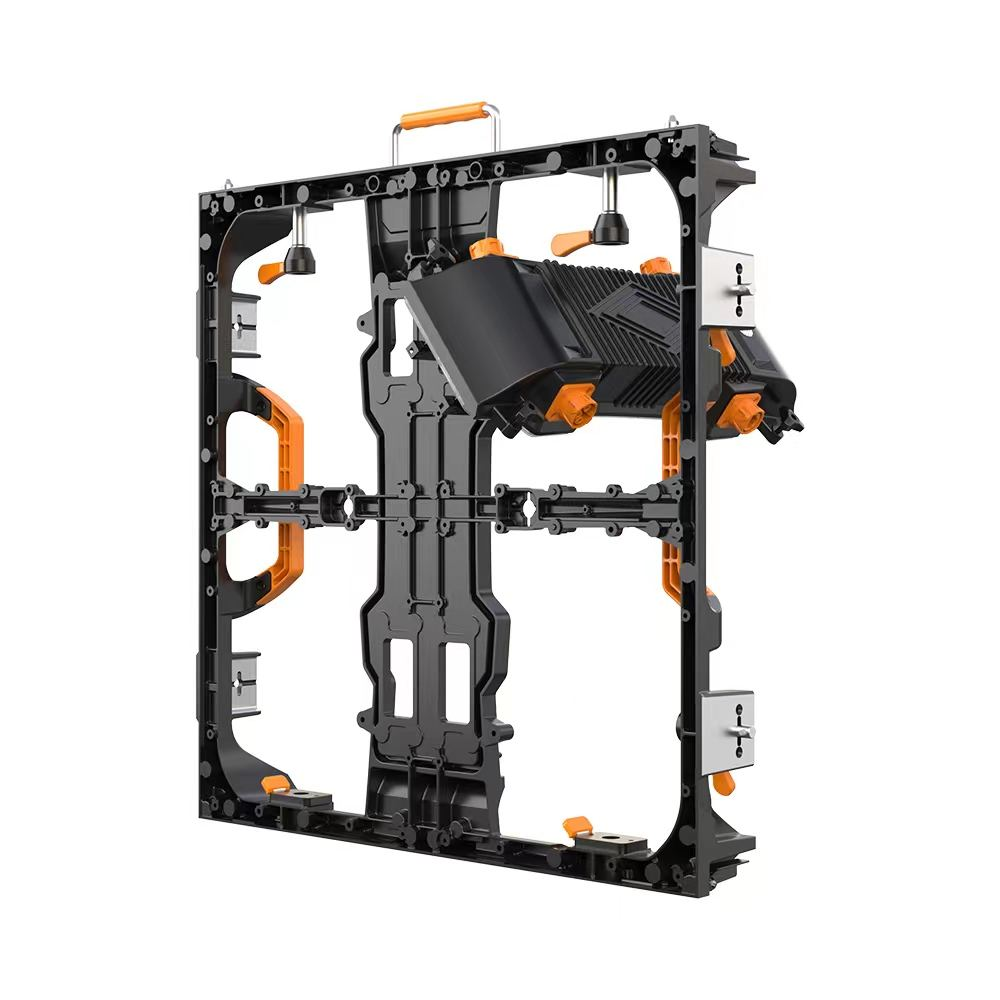
An LED wall can look clean from the audience position while dust is collecting between pixel masks, on cabinet vents, around cable entries, or inside the service area. Another screen may show fingerprints, airborne grease, construction residue, salt deposits, or rain-carried dirt. Treating all of these conditions with one cloth or chemical creates unnecessary risk.
A practical LED display cleaning plan begins with the installed product, contamination source, environment, access method, operating schedule, and manufacturer-approved limits. It then defines who may inspect the display, which tools and materials are permitted, how the system is placed into a safe service state, what evidence is recorded, and how the result is accepted.
Cleaning is an operating decision, not a cosmetic shortcut
Dust and residue can affect more than appearance. Deposits may reduce contrast, make local areas look uneven, restrict airflow, retain moisture, hide connector condition, or complicate service work. Aggressive cleaning can be worse: pressure, unsuitable liquid, abrasive cloth, uncontrolled air, or the wrong access tool may damage LEDs, masks, coatings, seals, connectors, or cabinet finishes.
The useful question is not “How often should every LED screen be cleaned?” It is “What contamination is present, which surfaces are affected, what method is approved for this product, and what condition will trigger action?” The answer changes between a quiet boardroom, a retail kitchen boundary, an outdoor roadside display, and a rental wall handled every week.
Identify the contamination before choosing a method
Inspect under consistent lighting with the display both off and operating on approved test content. Record the affected zone, likely source, severity, recent building work, weather exposure, ventilation state, and any change in image quality or temperature behavior. Do not assume that every mark is surface dirt; a visible patch may also come from module damage, alignment, calibration, or component failure.
On smaller screens, swipe horizontally to view all columns.
| Observed condition | What to investigate | Better buyer or operator question |
|---|---|---|
| Loose dry dust | Room filtration, construction activity, static attraction, vents, and service openings | Which dry-contact or non-contact method is approved for the module face and cabinet? |
| Fingerprints or handling marks | Touch points, front-service activity, public access, and surface coating | Which cloth and cleaning agent, if any, are approved for this exact surface? |
| Greasy or sticky residue | Cooking aerosols, smoke, stage effects, industrial processes, or unsuitable previous products | Should the affected module be removed and cleaned under a controlled service procedure? |
| Outdoor dust, salt, or traffic film | Prevailing wind, drainage, enclosure interfaces, corrosion signs, and local environment | What external cleaning method is compatible with the completed installation and its field interfaces? |
| Blocked vent or filter area | Airflow route, fan condition, filter design, cabinet temperature, and access clearance | Who maintains the ventilation path and what evidence defines a clean condition? |
| Unknown spots or discoloration | Moisture, chemical contact, surface damage, pixel failure, and calibration | Should work stop for technical diagnosis before any cleaning is attempted? |
If contamination appears near vents or cooling paths, coordinate the cleaning review with the LED wall thermal-management plan. Removing visible dust from the front does not prove that airflow, filters, fans, or rear clearances are in acceptable condition.
Confirm the display construction and approved limits
LED modules can differ in mask material, surface treatment, encapsulation, coatings, pixel structure, service method, and resistance to contact or liquid. Cabinet protection and finished-installation protection are also different questions. Field cable entries, connectors, seams, ventilation openings, drainage paths, and locally built structures may not share the same protection as a product enclosure.
For outdoor LED display cleaning, do not treat an IP label as permission to pressure-wash the screen. The outdoor LED display IP-rating guide explains why buyers should confirm which surfaces and interfaces are covered, under what test configuration, and who is responsible for site-created openings and drainage.
Request the current manufacturer procedure for the exact product and installed orientation. It should identify prohibited tools, contact pressure, compatible materials, liquid restrictions, drying or restart conditions, and any special treatment for damaged modules. When information is missing, stop and obtain clarification rather than improvising on the live wall.
Plan access and protect the work area
Cleaning scope is shaped by service access. A front-service wall may require protection for the visible face, floor, furniture, and removed modules. A rear-service installation needs safe clearance, lighting, housekeeping, and control of tools near power and signal equipment. Review the trade-offs in the front-service versus rear-service guide.
- Define the maintenance window, shutdown authority, isolation boundary, and restart owner.
- Control public access, nearby work, dust generation, liquids, and loose items around the display.
- Use an approved platform or access system where height is involved; do not stretch from furniture or improvised supports.
- Protect adjacent modules and finishes from tools, removed debris, and contact with equipment cases.
- Provide clean padded surfaces for any module that must be removed.
- Keep cleaning materials identified and separated from general building-maintenance supplies.
Create a product-specific LED wall cleaning procedure
The work instruction should be written for the installed wall, not copied from a generic housekeeping checklist. A typical controlled sequence follows the logic below, but each step must be aligned with the manufacturer’s instructions and the site’s safety rules.
- Confirm authorization, scope, responsible people, approved tools, and acceptance criteria.
- Photograph the display and record the visible condition before work begins.
- Place the system in the approved service state and verify the work boundary.
- Test the approved method on a small, less prominent area when the procedure allows.
- Remove loose contamination gently without driving debris deeper into the pixel surface or cabinet.
- Use only the approved material and technique for marks that remain; never mix chemicals or guess compatibility.
- Inspect seams, edges, vents, filters, cable entries, and access areas within the authorized scope.
- Allow any required drying or stabilization time before restart.
- Restore the system in the approved order and run the agreed visual and operational checks.
- Record the cleaned zones, materials, findings, exceptions, damage, and follow-up actions.
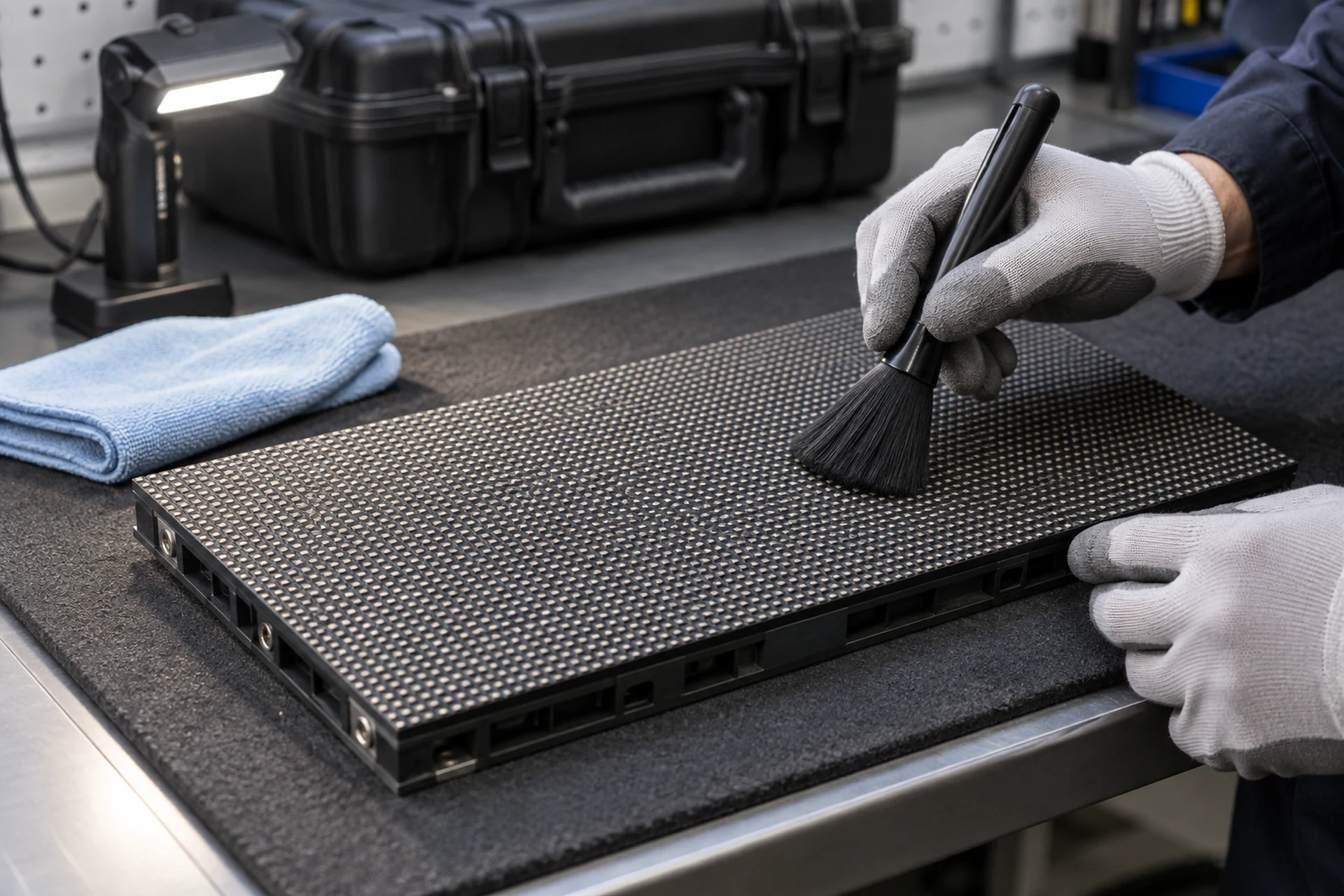
For LED screen dust removal, “more force” is not a measure of quality. The objective is to remove contamination without bending LEDs, scratching the mask, loosening components, forcing particles into gaps, or creating static and moisture risks. The correct brush, vacuum, cloth, or non-contact method is product-specific.
Separate routine surface care from technical service
Routine surface care may be performed by trained operations staff when the approved process is simple and the display remains closed. Opening cabinets, removing modules, cleaning internal power or data areas, servicing filters or fans, and working near electrical assemblies normally require a different authorization and competence level.
Define the handoff point clearly. Housekeeping personnel should not be expected to diagnose modules or select chemicals for electronic surfaces. AV technicians should not assume authority over building electrical isolation, elevated access, or public-area control. The manufacturer, integrator, facilities team, electrician, access contractor, and operator may each own a different part of the work.
Use condition evidence to set the schedule
A fixed calendar interval is easy to administer but may be too frequent for one site and too late for another. Combine scheduled inspections with condition triggers such as visible buildup, image-quality change, blocked ventilation, construction work, seasonal weather, public handling, event effects, or an environmental incident.
LED display preventive maintenance records should track inspection date, contamination type, affected zones, images, method used, materials, technician, abnormal findings, and next action. Over time, this history shows whether the interval fits the site and whether building filtration, access habits, or nearby processes need correction.
Add the cleaning procedure and history to the LED display as-built documentation. If cleaning reveals a damaged or mismatched module, route it through the documented LED module replacement plan rather than treating replacement as part of routine wiping.
Define acceptance after cleaning
Acceptance should confirm more than the absence of obvious dust. Inspect the screen off for marks, scratches, disturbed masks, raised modules, wet areas, residue, and debris at seams. Then operate the display using agreed dark, gray, bright, color, gradient, and real-content material. Check the normal audience positions and any camera view that matters to the application.
Confirm that ventilation paths remain clear, service panels and modules are secure, no tools or materials remain, alarms are normal, and the correct operating preset is restored. Record pre-existing defects separately from cleaning-related findings. Any new damage or unresolved contamination needs an owner, disposition, and completion date.
Put cleaning scope into the RFQ and service agreement
Cleaning is often excluded or described vaguely in a display quotation. Buyers should state whether the supplier is expected to provide the initial method, approved-material list, training, special tools, access assumptions, inspection form, periodic service, emergency contamination response, and waste or runoff controls. Compare what is included and who performs it before comparing price.
- Identify the indoor or outdoor environment and likely contamination sources.
- Provide screen dimensions, mounting height, service direction, and access restrictions.
- Define the cleaning and inspection boundaries for the display face, cabinets, vents, filters, structure, and control equipment.
- Assign shutdown, isolation, access, public-area, and restart responsibilities.
- Request product-specific prohibited and approved methods in writing.
- Agree on records, visual tests, exceptions, warranty notification, and acceptance authority.
Prepare a useful supplier discussion
Provide the application, product or module identification, indoor or outdoor location, screen size, mounting height, service access, operating hours, contamination source, current photographs, previous cleaning history, visible symptoms, shutdown window, local responsibilities, destination, and schedule. These details allow the supplier to respond to the real installation rather than a generic screen-cleaning question.
KSSdisplay can review the display-side information needed for a maintenance discussion and help identify product questions that should be resolved before work begins. Use the support resources for service context, or contact KSSdisplay with photographs, display identification, site conditions, access information, and the required maintenance window.
Conclusion
An LED display cleaning plan protects both image quality and serviceability. Identify the contamination, confirm the product construction, use an approved method, control access and shutdown, separate routine care from technical work, and verify the result under real viewing conditions. The goal is not the fastest visible wipe. It is a repeatable process that removes the right material without creating a new fault.
Frequently asked questions
Can an LED display be cleaned while it is operating?
Follow the product-specific procedure and site safety rules. Cleaning a powered display may expose people and equipment to unnecessary electrical, thermal, static, or moving-component risks. Use the approved service state and authorized personnel.
Can standard glass cleaner be used on an LED wall?
Do not assume so. LED modules are not ordinary glass panels, and chemicals can affect masks, coatings, adhesives, plastics, or residue behavior. Use only materials approved for the exact product.
Does an outdoor rating make pressure washing acceptable?
No general rating should be treated as approval for a cleaning method. Confirm the enclosure, installed interfaces, water direction, pressure limits, drainage, and manufacturer instructions first.
How often should an LED screen be cleaned?
Use the manufacturer’s guidance and site evidence. Environment, contamination source, airflow, public contact, operating schedule, and visual requirements can justify different inspection and cleaning intervals.
What should be recorded after cleaning?
Record the date, zones, contamination, approved materials and method, people involved, pre- and post-work images, abnormal findings, operational checks, damage, unresolved items, and next review date.