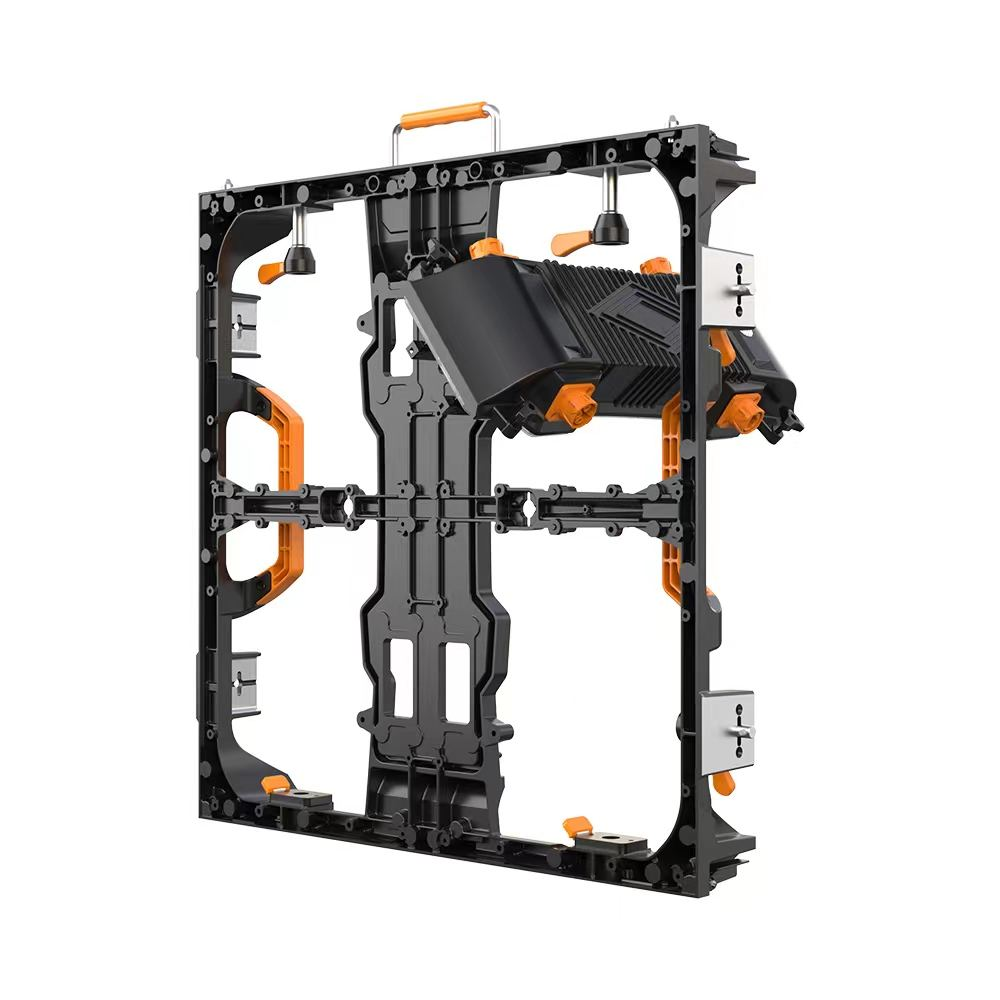
A technically impressive LED wall can still be the wrong choice for a quiet room. Cabinet fans, power supplies, processors, and the cooling system may be barely noticed in a busy lobby, yet become distracting in a boardroom, control room, podcast space, or virtual studio. The useful buying question is not simply whether an LED display is “silent.” It is whether the complete installed system meets an agreed acoustic target in every operating state that matters.
This guide explains how to turn LED wall acoustic noise into a measurable requirement. It helps consultants, integrators, procurement teams, and facility operators compare designs, assign responsibilities, and verify the result before handover.
Start with the room, not the cabinet label
No single noise figure describes every project. A display that is acceptable in a retail environment may be intrusive beside a conference microphone. The room background, distance from the wall, wall construction, thermal load, brightness schedule, and duty cycle all affect what people hear.
Define the use case before selecting hardware. For a conference room LED display, listen from the nearest seat and consider microphones, speech reinforcement, and video calls. In a virtual studio, check quiet takes, camera positions, and whether technical equipment can be moved outside the recording space. A control room may need a different test because operators sit in the space for long shifts.
Record these conditions in the design brief. If the room is not yet built, treat its assumed background level and cooling strategy as project inputs that the architect, acoustic consultant, MEP team, and AV team must coordinate.
What should an acoustic requirement include?
A phrase such as “low noise” cannot be accepted or tested. A useful requirement identifies the quantity, location, operating state, room condition, and evidence. ISO 16032:2024 describes an engineering method for measuring sound pressure from building service equipment in rooms; project teams should confirm its applicability and any local requirements with a qualified acoustician. The important lesson for an LED project is that the method and conditions must be stated, not assumed.
- Metric: state whether the requirement uses an A-weighted level, another weighting, octave-band data, or a room noise criterion.
- Position: identify listener, presenter, microphone, camera, and service positions where readings matter.
- Room state: document doors, HVAC, lighting, other AV equipment, and normal occupancy assumptions.
- Display state: define standby, typical content, stated brightness levels, maximum thermal load, and any boost mode.
- Duration: distinguish a stable continuous reading from startup, ramping, or fan-cycling events.
- Acceptance: name the instrument class, responsible tester, report format, tolerance, and retest process.
Do not copy a target from another room without checking the purpose of that space. The project’s acoustic consultant or responsible designer should establish the criterion. Procurement can then require each bidder to explain how its proposed configuration will be verified against it.
Where does LED wall noise come from?
The visible modules are only part of the system. Noise may come from cabinet fans, power-supply fans, processor or server fans, relay switching, coils, external ventilation, or nearby equipment racks. Air moving through a narrow cavity can add turbulence. A lightweight wall lining may also transmit vibration into the room.
Temperature changes the result. Fan speed may increase after the display has operated for some time, especially with bright content or a restricted rear cavity. A short demonstration immediately after startup can therefore miss the condition that appears during a long meeting or production session.
Tonal noise deserves attention as well as the overall number. A narrow hum, whine, or repeating fan cycle can be noticeable even when a headline sound-pressure value appears modest. Ask suppliers to identify operating modes and any control logic that can change the acoustic character over time.
Which design route fits a quiet room?
There is no universal winner. The right route balances acoustic performance, thermal safety, serviceability, brightness, redundancy, and cost.
On smaller screens, swipe horizontally to view all columns.
| Design route | Potential advantage | Questions to resolve |
|---|---|---|
| Fanless or passive cabinet design | Removes a direct rotating noise source at the wall | What ambient temperature, brightness, content load, and ventilation assumptions support the design? |
| Temperature-controlled fans | Can reduce noise during lighter operating conditions | At what temperature and load do fans change speed, and is cycling audible at the listener position? |
| Remote processors and support equipment | Moves rack noise away from the quiet room | What cable distances, signal design, rack cooling, access, and redundancy are required? |
| Acoustically treated rear cavity | May reduce transmission from the service space | Will treatment obstruct airflow, access, fire strategy, drainage, or maintenance? |
| Lower normal brightness or scheduled operation | May reduce thermal load in suitable applications | Does image performance still meet the viewing and camera requirement under actual room lighting? |
Fanless should not be treated as a complete guarantee. External power equipment, cooling, structure-borne vibration, or other AV devices may still dominate. Likewise, a fan-cooled design is not automatically unsuitable if the fan selection, speed control, isolation, airflow, and room layout are coordinated and verified.
Coordinate the wall, ventilation, and service access
Acoustic and thermal decisions are connected. Blocking ventilation to make a wall quieter can shorten component life or trigger higher fan speeds. Adding absorbent material without coordination can reduce the free area, trap heat, or complicate service. The display supplier should provide configuration-specific heat and airflow information; the MEP and acoustic teams should then design the room around the installed system, not a generic screen outline.
Access strategy matters too. A front-service wall may keep the rear cavity compact, but service work takes place in the occupied room. A rear-service wall needs safe clearance and may connect acoustically to adjacent spaces. Agree how doors, panels, seals, cable penetrations, and ventilation openings will be detailed, and who owns each interface.
What evidence should suppliers return with the bid?
Ask every bidder to answer the same schedule. A standalone cabinet value is useful only when its model, test distance, room, background level, operating temperature, brightness, content, fan state, and measurement method are known.
- Proposed cabinet, module, power supply, receiver, processor, and rack configuration.
- Cooling method for the display and every associated equipment location.
- Acoustic data with test conditions, measurement position, operating duration, and equipment state.
- Maximum expected heat output and airflow assumptions for the quoted configuration.
- Fan-control behavior, thresholds, service life assumptions, and field-replacement method where fans are used.
- Required rear cavity, ventilation openings, rack location, and maintenance clearance.
- Factory test proposal, site acceptance procedure, exceptions, and responsibility matrix.
AVIXA’s audiovisual systems performance-verification framework emphasizes defining what must be verified, when verification occurs, which criteria apply, and how results are reported. That approach is valuable here: make acoustic performance a named verification item before purchase, not a subjective complaint after installation.
How should acoustic commissioning be performed?
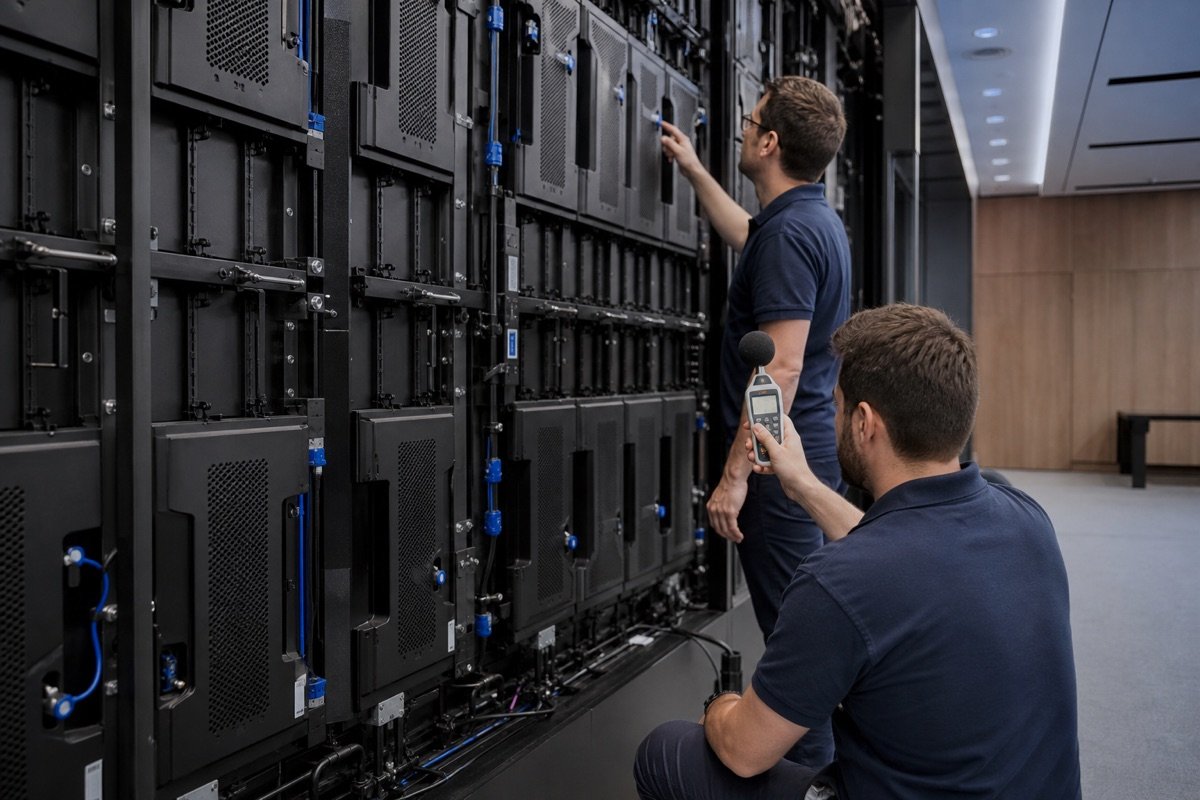
Test the completed room, but do not wait until completion to discover the risk. Use staged verification: review supplier evidence during design, test a representative sample or cabinet configuration when the acoustic target is critical, and repeat the agreed measurements after installation.
- Record the room background with the LED system and its dedicated cooling off.
- Measure standby, startup, representative content, normal brightness, and the agreed worst credible operating state.
- Allow the system to reach a stable thermal condition rather than testing only for a few minutes.
- Repeat readings at the named listener, microphone, presenter, camera, and adjacent-room positions.
- Note HVAC state, doors, room temperature, content, brightness, fan behavior, and all active rack equipment.
- Investigate tonal or cyclic noise even when the overall reading appears acceptable.
- Save instrument details, photos, configuration files, results, exceptions, and corrective actions in the handover package.
If a result fails, isolate sources one at a time. The remedy may involve cabinet settings, a faulty fan or power supply, vibration isolation, rack relocation, airflow changes, or room construction. Do not mask the symptom by applying a setting that creates a thermal or image-performance problem.
How does acoustic performance affect price and scope?
A quiet-room solution may change more than the cabinet price. Compare remote rack space, longer signal paths, passive-cooling design, acoustic treatment, structural isolation, ventilation, sample testing, specialist measurement, commissioning time, and access provisions. A lower equipment quote can become the more expensive project if these interfaces are excluded.
Separate base scope, options, and local works. Identify who supplies the display, processors, racks, cooling, acoustic treatment, power, data, structure, doors, seals, testing, and remedial work. This makes bids comparable and prevents a performance requirement from falling between the display supplier and building contractor.
Plan a quieter LED wall with KSSdisplay
Begin with the room and operating brief, then use the small-pixel-pitch LED display range and KSSdisplay application solutions as starting points for configuration discussions. Product selection should follow the project’s verified visual, thermal, acoustic, access, and budget requirements.
For a project-specific proposal, contact KSSdisplay with the room use, screen dimensions, nearest listener and microphone positions, brightness schedule, daily operating hours, ambient and HVAC assumptions, rack location, service-access plan, acoustic criterion, test method, destination, and delivery schedule. Those inputs allow the supplier and project team to discuss a buildable system instead of relying on a vague “silent display” label.
Frequently asked questions
Are fanless LED walls completely silent?
Not necessarily. Removing cabinet fans eliminates one source, but power supplies, processors, remote racks, HVAC, coil noise, and vibration paths can remain. Verify the complete installed system under agreed room and operating conditions.
Can a supplier’s cabinet noise figure predict room performance?
Only when the test configuration and conditions are relevant. Ask for the cabinet model, quantity, operating temperature, brightness, content, fan state, distance, background level, room description, and measurement method, then relate them to the actual installation.
When should an LED wall noise test take place?
Review data during design, test a representative configuration when the risk is high, and measure the completed installation at commissioning. The site test should include enough operating time for the wall and cooling system to reach realistic thermal conditions.
Who should own the acoustic acceptance criterion?
The project’s responsible designer or acoustic consultant should define the room criterion and measurement method. The display supplier, integrator, MEP team, and building contractor should then have clearly assigned interface and test responsibilities.