Choosing a direct-view LED wall for a meeting room is often reduced to one number: pixel pitch. That shortcut can lead to an expensive screen that still does not make spreadsheets, dashboards, and small text easy to read. A better specification starts with the closest and farthest viewers, the content they must understand, the wall dimensions, and the available signal resolution. Pixel pitch is the result of those decisions—not the first decision.
Start with the viewing task
A presentation screen can support very different tasks. In a boardroom, viewers may need to read financial tables and annotations. In an all-hands room, the same wall may mostly show speakers, videos, and large headlines. The second use can tolerate less fine detail than the first.
AVIXA’s Display Image Size for 2D Content in Audiovisual Systems (DISCAS) standard frames display planning around the viewer’s relationship to the image, including content detail and viewing position. Even when a project team does not calculate every value from the standard, the principle is useful: define what the farthest person must discern and what the closest person can view comfortably.
Translate room geometry into a practical pitch range
Pixel pitch is the center-to-center distance between adjacent pixels, usually stated in millimeters. A smaller pitch places more pixels in a given area. That can improve apparent detail at close range, but it also increases pixel count, processing load, component quantity, and usually purchase cost.
A common early estimate is to compare the pitch in millimeters with the closest viewing distance in meters. This is only a screening rule, not an acceptance criterion. Real results also depend on content, brightness, contrast, cabinet alignment, LED package, video processing, and the viewer’s eyesight. Treat the estimate as a way to shortlist pitches for an on-site or full-size sample test.
On smaller screens, swipe horizontally to view all columns.
| Project input | Question to answer | Effect on specification |
|---|---|---|
| Closest viewer | Will pixels or module seams be distracting? | Sets the practical upper limit for pitch |
| Farthest viewer | Can the smallest required detail be read? | Influences image size and text size |
| Content type | Video, slides, dashboards, CAD, or fine text? | Determines required detail |
| Wall dimensions | What physical image fits the room? | Determines native pixel dimensions |
| Source format | What resolution and aspect ratio will be sent? | Affects scaling and processor selection |
Calculate the wall’s native resolution
Native resolution connects cabinet selection to real content. Divide the active width and height in millimeters by the proposed pixel pitch. For example, a 4,800 mm by 2,700 mm active area at 1.5 mm pitch contains approximately 3,200 by 1,800 pixels. The same wall at 1.2 mm is approximately 4,000 by 2,250 pixels.
This calculation helps the AV designer decide whether the wall should display a source pixel-for-pixel, scale it, crop it, or place multiple sources on a canvas. It also reveals whether a narrower pitch creates resolution that the normal source and content will rarely use.
Check the cabinet grid before approving the wall size
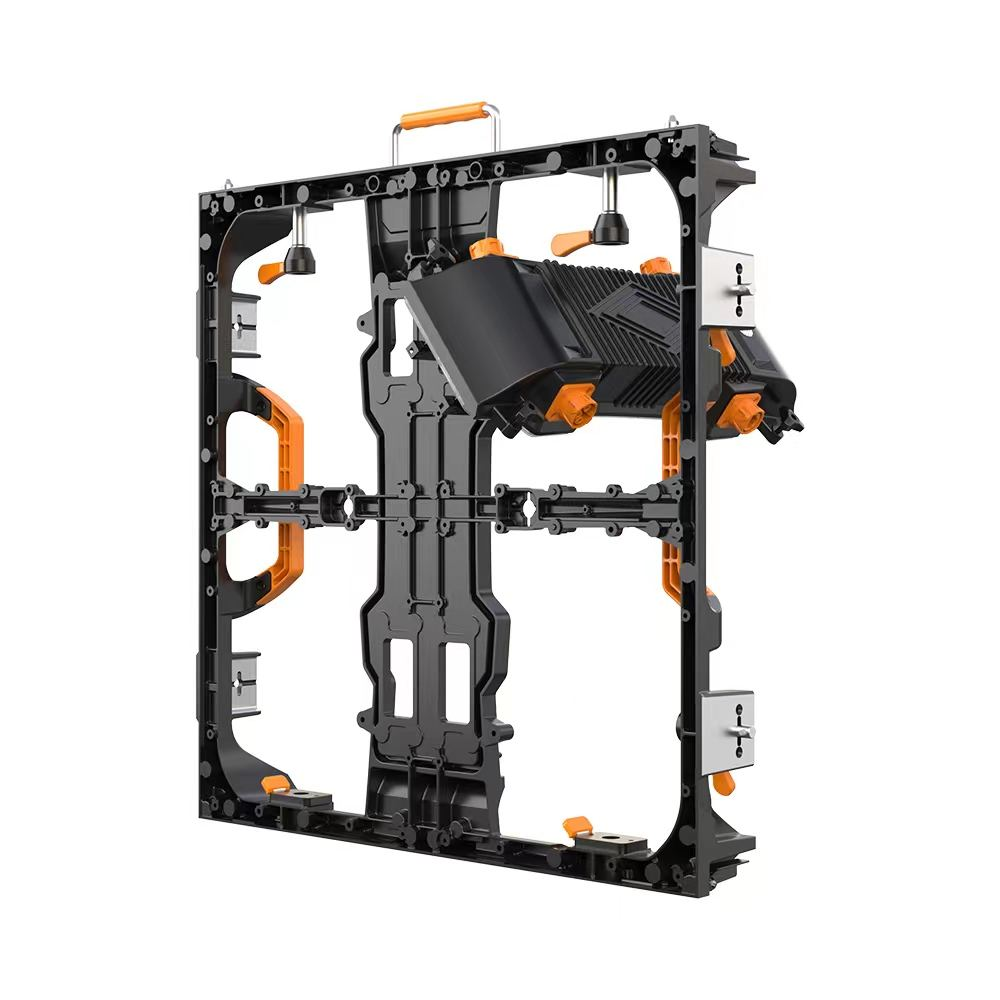
An LED wall is assembled from cabinets and modules, so the finished dimensions must follow a buildable grid. A design drawn as an arbitrary architectural rectangle may need to grow, shrink, or change aspect ratio when translated into real cabinets. Ask the supplier for the exact active area, cabinet matrix, total pixel dimensions, installed depth, weight, and power estimate.
KSSdisplay’s small-pixel-pitch LED display options provide a starting point for comparing indoor configurations. For a complete room, the conference room LED display solution shows how the display fits into a wider collaboration environment.
Request a content-based sample test
A showroom demo should use the buyer’s real content, not only saturated promotional video. Bring a representative spreadsheet, presentation, conferencing layout, dark interface, skin tones, and small text. View them from the intended closest, typical, and farthest seats. Check the screen at the brightness expected in the actual room, because an over-bright demo can hide black-level and comfort issues.
Include camera performance when meetings are recorded
If the wall will appear behind speakers or remote participants, add the room’s production cameras to the sample test. Camera shutter settings, scan method, refresh behavior, brightness, and processor configuration interact in ways that are not visible to the eye alone. Test wide and close shots, slow pans, and common background colors. Ask the integrator to save an agreed camera-friendly configuration so normal users do not have to rebuild it for every call.
- Confirm readable text size at the farthest seat.
- Look for visible pixel structure and moiré at the closest seat and on camera.
- Check uniformity across cabinet boundaries using gray and near-black test patterns.
- Verify the processor accepts the intended inputs and canvas dimensions.
- Review front-service clearance, ventilation, trim, and access to power and data.
Avoid paying for pitch while overlooking system quality
Two walls with the same pitch can perform differently. Cabinet flatness, calibration, receiving cards, scan configuration, low-gray behavior, redundancy options, and installation accuracy all matter. Ask how the supplier will document factory testing and final calibration. KSSdisplay’s quality-control overview lists useful checkpoints to discuss before approval.
Also confirm how signal loss, a failed power supply, or a failed receiving path will appear during a meeting. A critical boardroom may justify redundant signal paths or power arrangements that a casual presentation room does not need. Reliability choices should follow the business impact of downtime rather than a generic feature checklist.
What to send with your RFQ
For a useful recommendation, send a room plan, wall width and height limits, closest and farthest viewing distances, typical content, source resolution, ambient-light conditions, camera requirements, service-access preference, and target installation date. These inputs allow suppliers to compare a few defensible options instead of simply quoting the smallest pitch.
If you are planning a meeting-room wall, contact KSSdisplay with those dimensions and content samples. The team can help translate the room and viewing task into a buildable cabinet and resolution plan.