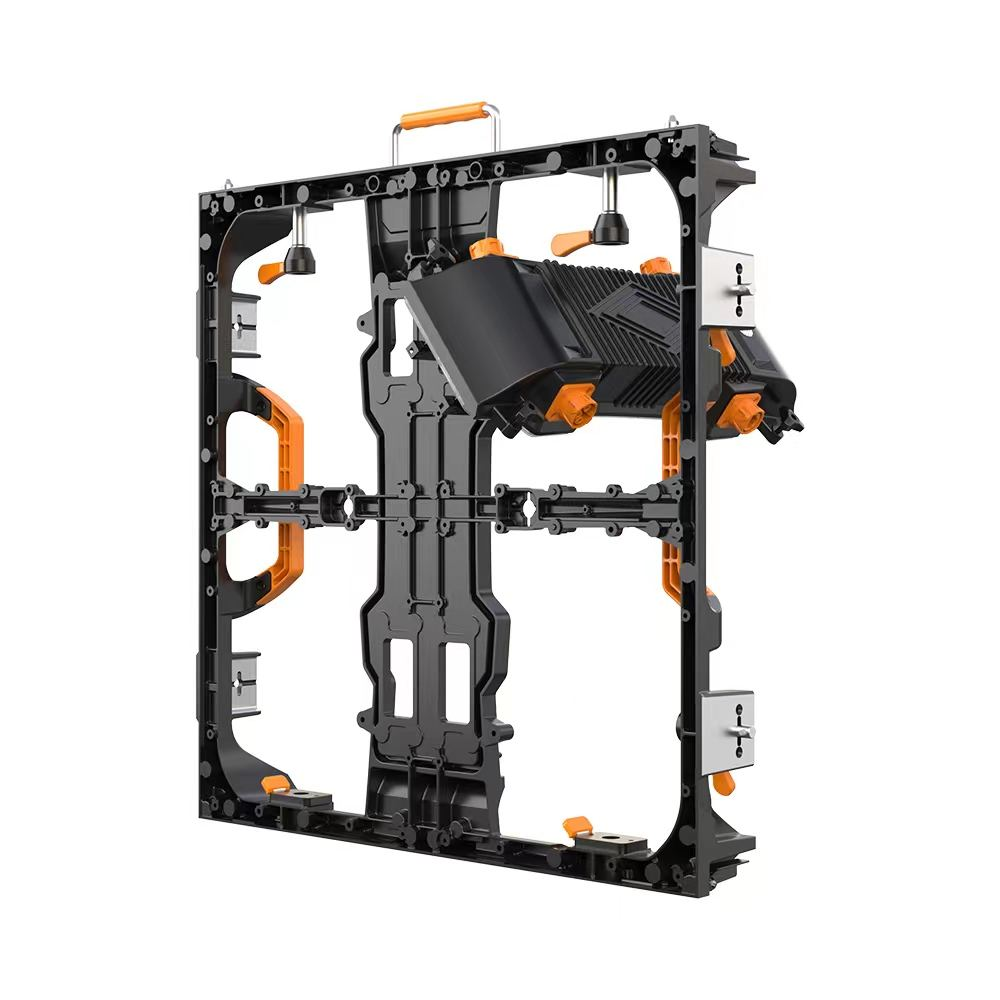
An LED display sample evaluation should answer a defined purchasing question: does the proposed configuration suit the intended content, viewing conditions and service requirements? Agree the sample identity, test setup, acceptance criteria and permitted differences from production before the demonstration. Record what was observed, what was measured and what remains unverified. Approving an attractive image without those boundaries leaves too much uncertainty for the production order.
This guide is for buyers, integrators and project teams evaluating a module, cabinet or demonstration wall before committing to an LED display purchase. It focuses on sample approval. Factory acceptance of the completed order and commissioning at the installation site are separate decisions with their own evidence.
Start with the decision the sample must support
Write down the uncertainty that justifies the sample. It might be whether small text remains usable from a planned seat, whether a surface finish fits the interior, whether adjacent cabinets align satisfactorily or whether the proposed service method works in the available space. Each question calls for a different demonstration.
A single module can help you inspect its visible surface and construction. It cannot demonstrate the seams of a large assembled wall. A showroom wall can support an image review, but its brightness setting, signal processing and room lighting may differ from the quoted installation. Define what the available sample can reasonably establish before paying for freight or organizing a visit.
Start from the room or site brief. Record screen dimensions, active image area, nearest and farthest viewers, typical content, ambient lighting, service access and any camera workflow. The LED display site survey checklist provides the project information needed to turn a general product demonstration into a useful buying decision.
Agree who makes the decision. Procurement may approve commercial conditions, the AV team may approve the signal workflow, and the owner may judge whether the content supports daily use. One person’s approval should not silently stand in for every discipline.
Identify exactly which sample is being demonstrated
Request a sample record that connects the physical item to the proposal. Include the product designation, relevant hardware revision, module or cabinet identifiers, controller configuration, software or firmware versions where relevant, and the date of the review. Identify whether the item is a current production example, a prototype or a demonstration assembly.
Ask the supplier to list differences between the sample and the proposed production order. A different controller, protective surface, cabinet arrangement or calibration state may change the relevance of the demonstration. A difference does not automatically disqualify the sample, but it should limit what the buyer signs off.
Keep that record with the quotation revision. If the commercial offer changes after evaluation, check whether the approved evidence still applies. The phrase “same specification” is not enough when the underlying configuration has changed in a way that matters to the project.
Do not infer that a photograph shows the exact item that will ship. Request identifiers and written confirmation of the sample’s relationship to production. Where retaining a reference sample is useful, agree who holds it, how it is identified and how long it remains available.
Choose a sample format that matches the question
On smaller screens, swipe horizontally to view all columns.
| Sample format | Useful evidence | What remains outside its scope |
|---|---|---|
| Unpowered module or material sample | Surface appearance, accessible construction details and physical fit against agreed drawings | Powered image behavior, system operation and assembled-wall consistency |
| Powered module or single cabinet | Local image review and operation in the documented setup | Multi-cabinet alignment, full-wall mapping and large-system behavior |
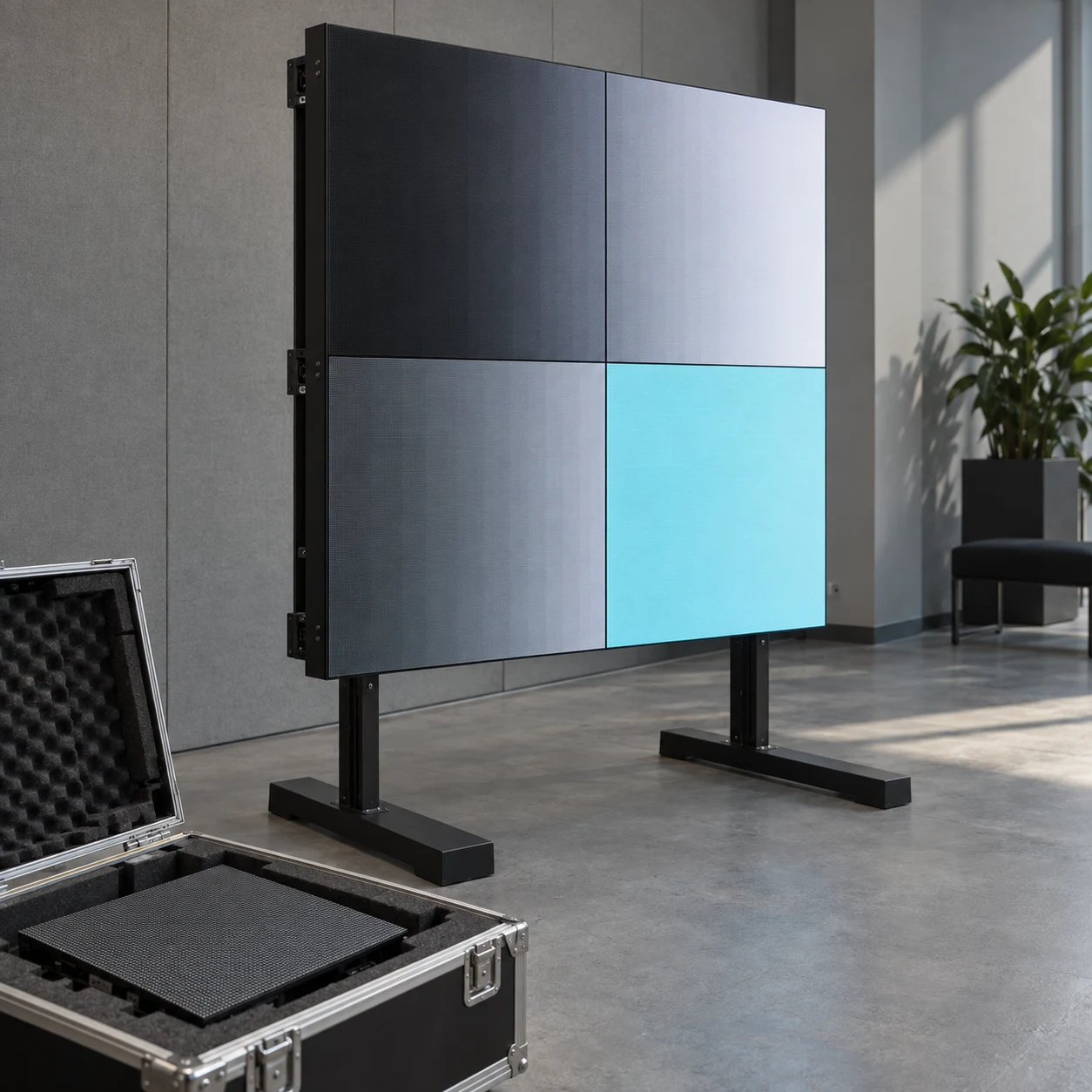
| Multi-cabinet demonstration assembly | Adjacent-cabinet appearance, representative content and agreed control workflow | Final site lighting, full installation structure and every production unit |
| Project-specific mock-up | A defined interface, viewing position, service task or architectural detail | Conditions not reproduced in the mock-up and untested production variation |
| Remote demonstration | Witnessed operation and selected records when travel is impractical | Reliable judgement of every optical characteristic through an uncontrolled camera and display chain |
Use the table to select scope rather than rank formats. A smaller sample may be entirely adequate for a finish decision. A larger demonstration is justified when the unresolved question depends on neighboring cabinets, audience position or system integration.
Record any temporary supports, source equipment or demonstration-only accessories. Sample approval should not be mistaken for approval of the finished mounting structure, electrical installation or local compliance. Those responsibilities remain with the appropriate qualified parties and the project acceptance process.
Bring the content viewers will actually use
Include representative project files in the evaluation plan. A presentation room may need slides, spreadsheets and video conferencing layouts. A retail installation may rely on product imagery and short motion sequences. A control application may need several windows visible at once. Evaluate the actual task instead of relying entirely on a supplier’s promotional video.
Document the source resolution, scaling, window layout and active image area. Content that fills the demonstration wall may occupy only a smaller window in the installed system. Conversely, a source can look poor because of its preparation or scaling even when the display is operating as intended. The content resolution and aspect-ratio planning guide helps keep source, canvas and display decisions connected.
AVIXA’s display image size guidance distinguishes the active image area from the overall display and relates content elements to image height and viewing positions. For a sample review, the practical implication is to evaluate the important content at its intended size and position, not simply ask whether the screen looks sharp from nearby.
If the sample cannot reproduce the full display dimensions, identify that limitation. Do not enlarge a small text element for convenience and then treat the demonstration as evidence that the original layout will be readable at the back of the room.
Compare under recorded viewing and operating conditions
Record the room lighting, viewing positions, operating brightness setting and source chain for each comparison. If competing samples use different setups, disclose those differences before interpreting the result. A comparison made under uncontrolled conditions is useful as an impression, but weaker as an approval record.
Use agreed test content alongside real project material. Uniform fields, grayscale ramps, motion sequences or fine-detail content may help investigate a particular issue, but the method and expected result should be defined by the project’s technical team. Avoid assigning a universal pass threshold to every application.
Evaluate the intended operating range where it matters. A demonstration at one bright setting does not establish suitability for a quiet, dim presentation room or for every operating mode. Ask which settings were changed during the review and preserve the final configuration with the results. Use the color uniformity and calibration acceptance guide when that characteristic is part of the purchasing decision.
Separate observations from measurements. “The boundary was visible from the agreed seat” records an observation. A numerical luminance or color claim requires an appropriate method, instrument, setup and record. Request those details when the number is part of acceptance; do not convert a phone photograph into a measurement report.
If cameras matter, include the camera workflow
For filmed presentations, live events or studio work, agree a camera test that reflects the intended equipment and operating conditions. Identify the camera, lens, frame rate, shutter settings, exposure and relevant display configuration. Preserve representative recordings and the settings that produced them.
A sample can look satisfactory to a person while a particular camera setup reveals a different issue. Equally, a remote video can introduce artifacts that are not visible in person. The LED display camera flicker testing guide explains why the actual capture workflow deserves a defined test rather than a decision based only on a headline refresh-rate figure.
Do not let a successful recording imply compatibility with every camera or every setting. State the tested combinations and identify any additional combinations that need review before production approval.
Review handling and service access as separate checks
If cabinet assembly, module removal or service access is part of the decision, request a demonstration by trained personnel using the manufacturer’s procedure. Observe the required clearance, tools, handling arrangement and restoration checks. Record which conditions were reproduced and which depend on the final installation.
A sample on an open bench offers access that may not exist behind a finished wall. Compare the proposed access method with the project drawing and nearby architectural features. If a service demonstration requires moving the sample away from its mock-up position, record that as a limitation rather than evidence that the installed arrangement is serviceable.
Treat unpowered physical inspection and powered operation as different activities. The sample review is not a reason for unqualified buyers to open energized assemblies or improvise electrical tests. Specialist checks should be scoped and performed by the responsible qualified team.
Create a sample approval record that production can use
A useful record should be specific enough for someone who missed the demonstration to understand the decision. Include the sample identity, quotation revision, participants, content files, test conditions, criteria, observations, measured results where available, exceptions and supporting photographs or recordings.
AVIXA’s public overview of Audiovisual Systems Performance Verification describes a framework for selecting verification items, timing, criteria and reporting. The record below applies that evidence-oriented approach to a buyer review; it is not a certification claim or a substitute for the standard.
Use clear outcomes for each criterion:
- Approved for the stated configuration and conditions, with a reference to the evidence.
- Approved with a defined exception, responsible person and required closure evidence.
- Further review required because the sample or setup did not reproduce the relevant condition.
- Not approved because the documented result did not meet the agreed criterion.
Keep unresolved items visible. “Approved subject to improvements” is too vague to guide production. Describe the required change, who confirms it, whether a new sample is needed and which part of the order remains on hold pending that decision.
Connect sample approval to production and final acceptance
Before release, ask the supplier to confirm how the approved sample configuration maps to the production order. Identify relevant revisions, permitted substitutions and the change-notification process. Agree which changes require renewed buyer review instead of leaving that decision until goods are ready to ship.
Where production consistency is a concern, define the appropriate inspection and evidence with the supplier or qualified quality team. A single approved sample does not establish the condition of every unit in a shipment. Avoid inventing a sample quantity or acceptance limit without a justified inspection plan.
Keep the purchasing stages distinct. Sample evaluation supports selection; the factory acceptance test reviews the ordered system before shipment under an agreed scope; site commissioning checks the installed result. Evidence can carry forward, but later stages still need to address their own configuration and environment.
If the sample is returned, preserve its identity and approval package. If it is retained, agree storage, ownership and any conditions that affect its usefulness as a reference. Do not rely on an unlabelled demonstration unit or a compressed messaging-app video as the only record of an important buying decision.
Request a sample evaluation scope before requesting a price
For an LED display sample evaluation, send the proposed application, screen dimensions, viewing positions, representative content, installation conditions and the specific uncertainty you want to resolve. Include any intended cameras or service-access constraints that change the review. Ask which sample format and configuration the supplier proposes, what it can demonstrate and what will remain unverified.
Clarify the sample fee or deposit if applicable, freight, return arrangements, demonstration equipment, technical attendance and timing. These are project terms to confirm, not universal inclusions. Request the approval record and proposed production relationship as deliverables alongside the physical sample.
Use the KSSdisplay enquiry form to discuss the required evaluation scope and confirm sample availability for the proposed configuration. A focused request gives the supplier a practical question to answer and gives the buyer evidence that can support the order.
Frequently asked questions
Is a demonstration video enough to approve an LED display?
A video can support an evaluation, especially for witnessed functions, but its camera, compression, exposure and playback display limit optical judgement. Record the original setup and request additional evidence for any criterion the video cannot establish.
Should every project order a full-size sample wall?
No. Select the sample size from the unresolved decision. A material review may need only a small sample, while a seam, layout or service-access question may need a larger assembly or mock-up. Document what the chosen size cannot prove.
Can a supplier change a component after sample approval?
Define the permitted changes and notification process in the order documentation. A change that affects an approved characteristic should be reviewed against the evidence and may require a new demonstration. Do not assume that the product name alone preserves the approved configuration.
Does sample approval replace factory or site acceptance?
No. It supports the purchasing choice for a documented configuration. Factory and site acceptance address the ordered equipment and completed installation under their own agreed conditions.