An LED display maintenance budget should fund the service outcome the owner needs, not just a box of spare modules or a fixed number of visits. Start with the screen inventory, operating calendar, access conditions and required response. Then separate predictable annual work from usage-driven repairs, project changes and a controlled contingency. Assign every line to an owner and state the evidence needed before money is released.
There is no reliable universal percentage of purchase price that fits every LED display. A lobby wall with easy front access and planned downtime has a different cost profile from a roof-mounted billboard or a screen supporting ticketed events. This guide shows how to build comparable budget categories without inventing failure rates, supplier prices or service promises.
What belongs in an LED display maintenance budget?
Include the activities and resources required to keep the installed system supportable during the budget period. The scope may cover inspection, cleaning, remote support, preventive work, corrective labor, access equipment, approved spares, configuration records, logistics and acceptance testing. It may also need training, software or controller support and an allowance for items that are known to be approaching end of support.
Do not combine every future display cost into one line called “maintenance.” Expansion, relocation, content production, building electrical upgrades and planned screen replacement are different decisions. They can appear in the same asset plan, but separating them prevents a maintenance variance from hiding a capital change.
The public overview of ISO 55000:2024 describes asset management as a lifecycle approach to realizing value and links it with financial performance and risk management. The framework below applies that general idea to LED display budgeting. It is not an ISO conformity assessment and does not prescribe a specific amount.
Begin with the service requirement, not last year’s total
Copying last year’s spending can repeat gaps that were never recorded. Define the operational requirement first: when the screen is needed, what degradation can be tolerated, how quickly a problem must be assessed, which work can wait for a planned window and what business event changes the priority.
List every display covered by the budget. Record its location, application, dimensions, installation and service-access method, control configuration, operating hours or calendar, warranty status, available stock and responsible contacts. Link the budget to the as-built documentation plan so quotes refer to the real installed configuration rather than a generic product family.
For multi-site portfolios, group screens only when the service assumptions are genuinely similar. A shared model name does not make travel, height access, environmental exposure, local labor rules or permitted working hours identical.
Separate fixed, variable and conditional costs
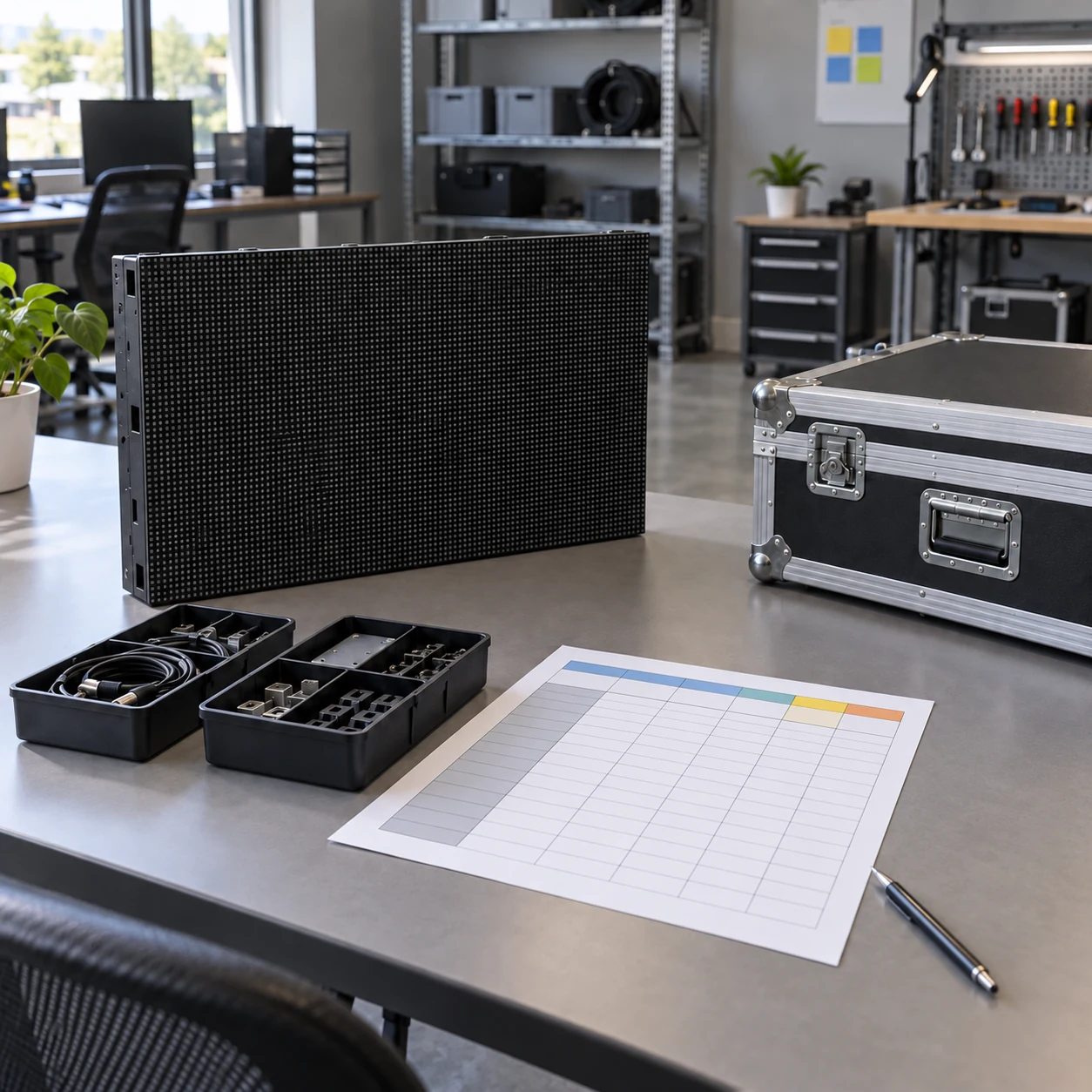
A clear budget distinguishes costs by what causes them. This makes approval easier and stops a preventive-maintenance contract from being compared with a quote that includes emergency access, freight and spares.
On smaller screens, swipe horizontally to view all columns.
| Budget layer | Typical scope | Planning basis | Approval evidence |
|---|---|---|---|
| Fixed planned service | Scheduled inspection, cleaning, reporting and agreed remote review | Defined sites, visit frequency, access window and deliverables | Service schedule and accepted report template |
| Retainer or SLA coverage | Availability, triage channel and agreed response process | Service hours, response definitions, exclusions and escalation route | Signed scope and measurable service terms |
| Usage-driven corrective work | Technician time, approved replacement work and post-repair testing | Failure history, installed quantity and repair route | Incident record, diagnosis and authorized work order |
| Access and site support | Lift, scaffold, traffic control, permits, escorts or venue labor | Location and method for each planned or emergency visit | Site plan, supplier quote and named responsibility |
| Spare-parts holding | Qualified modules, cards, power assemblies or other approved stock | Installed base, consumption, repair turnaround and supply risk | Stock record, exact part identity and replenishment rule |
| Logistics | Local delivery, outbound return, insurance, customs or temporary export | Service route and responsibility under the project terms | Shipment scope, RMA or repair reference |
| Training and documentation | Operator refresh, configuration backups, drawings and record updates | Staff changes, configuration changes and audit findings | Updated controlled records and attendance evidence |
| Conditional project work | Major calibration, subsystem migration or environmental correction | Triggered by inspection, change or obsolescence decision | Separate proposal, acceptance criteria and approval |
| Contingency | Defined uncertainty not assigned to another line | Documented exposure and approval threshold | Release authority, reason and post-use review |
Contingency is not a substitute for an incomplete scope. State what uncertainty it addresses and who can release it. If a known item already has an expected time and scope, put it in the main budget rather than hiding it in a reserve.
How should preventive work be priced?
Ask for the work package, not just a visit count. One visit might include a visual inspection only; another may include isolation, internal access by qualified personnel, cleaning, torque checks where specified, configuration backup, sample testing and a written defect register. These are not equivalent services.
For each planned visit, define the display state, access method, working hours, attendance, tools, consumables, areas to inspect, excluded work and required report. State who supplies the lift or scaffold, who isolates power, who restores content and who approves completion. The LED display cleaning plan helps separate routine operator care from work requiring a trained service team.
Tie frequency to the operating environment, manufacturer instructions, site experience and criticality. Do not publish a single service interval as a rule for every installation. Dust load, weather exposure, audience schedule and access cost can change the sensible plan.
How much should be allowed for corrective maintenance?
Use evidence before using a percentage. Start with confirmed incidents and repairs for the same installed population. Separate repeat faults from unrelated events, and separate component failures from content, configuration, network, building-power or accidental-damage issues. The maintenance log template provides the record needed to make that distinction.
For each event type, identify the likely service route: remote triage, local technician, specialist visit, depot repair, warranty return or approved substitution. Add only the costs that belong to the owner under the contract. A warranty-covered part may still involve access, diagnosis, removal, packing, freight or reinstallation. The warranty claim and RMA guide explains how to keep those responsibilities visible.
When reliable history does not exist, document an assumption range instead of presenting a precise forecast. Record the installed quantity, observation period, source of the assumption and the event that will trigger a mid-year review. The budget should become more evidence-based as the maintenance history grows.
Budget spare parts as controlled service capacity
Spare stock has value only when it is compatible, usable, findable and reserved for the intended screen. Budget for identification, storage, inspection and controlled issue as well as purchase. A low-cost part with an unknown revision can increase recovery time rather than reduce it.
Link every stock line to an installed configuration and a replenishment decision. State the minimum operational balance, repair or reorder route, expected verification and the person who can release stock. Do not treat the original project allowance as a permanent failure forecast.
Review supply status before approving a large buy. When a part is nearing end of production, compare a controlled last-time buy with repair and migration options. The obsolescence replacement planning guide provides that decision framework.
Do access, travel and downtime need separate lines?
Yes, when they materially affect scope or ownership. Access can cost more than the small component being replaced, especially where work needs a lift, road closure, roof permit, after-hours venue window or multiple qualified trades. Hiding access inside a single labor rate makes supplier comparisons unreliable.
Request separate assumptions for mobilization, travel, accommodation, minimum call-out, working hours, access equipment, permits, escorts and weather-related remobilization. Clarify whether remote triage is charged separately and whether it can prevent a site visit.
Do not insert an invented revenue-loss figure for downtime. Ask the owner to define business impact, critical dates and the latest acceptable restoration point. The service budget can then price the response needed for that real requirement.
How do you compare maintenance quotations fairly?
Normalize the offers before comparing totals. Place each supplier against the same asset list, service hours, response definitions, visit scope, access assumptions, spare-stock position and reporting deliverables. Mark every blank as excluded or unconfirmed rather than assuming it is included.
On smaller screens, swipe horizontally to view all columns.
| Comparison question | What a comparable answer should show |
|---|---|
| What assets are covered? | Exact screens, locations, subsystems and start/end dates |
| What does a planned visit include? | Tasks, access, personnel, consumables, report and acceptance |
| What does “response” mean? | Acknowledgement, remote assessment, dispatch or restoration, stated separately |
| Which costs are fixed? | Retainer, planned visits, included support hours and defined deliverables |
| Which costs remain variable? | Labor rates, call-outs, travel, access, freight and parts markup or handling |
| What is excluded? | Building work, network, content, permits, damage, unsupported parts or other boundaries |
| How are changes approved? | Quote threshold, named authority and evidence required before work |
| How is performance reviewed? | Case records, service reports, stock changes and agreed KPIs |
Price is meaningful only after scope is aligned. A lower annual fee may be appropriate when the owner provides access and local labor. A higher fee may include resources that another supplier leaves variable. Make that allocation explicit rather than treating one structure as automatically better.
Build a 12-month budget calendar
Map predictable work to the operating calendar. Place inspections, deep cleaning where applicable, stock review, operator refresher training, configuration backup review and contract renewal before critical events rather than after them. Add decision dates for parts with supply or support uncertainty.
Include a quarterly or project-appropriate variance review. Compare planned and actual spend, but also examine open defects, response evidence, repeat failures, stock balance and deferred actions. The maintenance KPI and service dashboard can support the review without turning every metric into a payment target.
When the operating schedule changes, update the service plan and budget assumptions together. More events, longer daily use, new content equipment or restricted access can change both exposure and response cost even when the display hardware is unchanged.
When should maintenance spending become a replacement decision?
Do not use age alone. Escalate when the current support route no longer meets the required service, when approved critical parts cannot be sourced in the needed window, when repeated work does not restore the agreed outcome, or when continued repair depends on unsupported configurations. Define these triggers before the budget year begins.
Prepare replacement as a separate option with scope, integration, downtime, acceptance and handover costs. Compare it with continued support over the same planning horizon. Avoid calling every upgrade “maintenance,” because doing so obscures capital approval and makes year-to-year performance impossible to interpret.
What should you send for a maintenance budget proposal?
Provide the screen inventory, locations, applications, installation and access method, operating calendar, critical dates, current service records, configuration documents, usable stock, warranty status and required response. State which local resources the owner provides and which costs the supplier must include.
Use the KSSdisplay enquiry form to request a project-specific scope. Ask for confirmed inclusions, exclusions, assumptions, variable rates, reporting deliverables and the evidence needed to authorize additional work. That produces a more useful discussion than asking for one universal annual maintenance price.
Frequently asked questions
Is there a standard annual maintenance percentage for LED displays?
No universal percentage is reliable for every project. Screen quantity, application, environment, access, operating schedule, service level, spare stock and responsibility split all change the budget. Use the percentage only as an internal provisional assumption if its basis and review trigger are documented.
Should spare parts be treated as operating or capital expenditure?
That classification depends on the organization’s accounting policy, materiality and the nature of the item. The technical plan should identify the part, purpose, expected use and ownership; the finance team should determine the accounting treatment.
Does a maintenance contract include replacement parts?
Only if the signed scope says so. Confirm included stock, exclusions, repairable items, markups, freight and approval thresholds. Do not infer parts coverage from the words “full service” without a definition.
How often should the maintenance budget be reviewed?
Review it at the organization’s normal planning interval and when a material trigger occurs, such as repeated failure, stock depletion, a supplier notice, an operating-calendar change or loss of an approved repair route. Critical-event sites may need more frequent operational reviews than the annual finance cycle.
Should emergency work come from contingency?
Only when it fits the defined contingency purpose and approval rule. If emergency response is a predictable service requirement, budget the retainer, call-out structure and access assumptions explicitly, then use contingency for the remaining documented uncertainty.